Short Bio
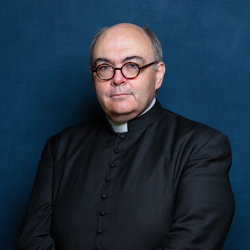
Stephen Morgan has been Rector of the University of Saint Joseph since 2020. Originally from Wales in the UK, he is an Associate Professor of Theology and Ecclesiastical History.
After a career in finance in the City of London and Hong Kong, he spent fifteen years as the CFO/COO of a large not-for-profit in the UK. Returning to academic work in 2009, he read for a DPhil in Theology at the University of Oxford, where he was a post-doctoral Research Associate of St Benet’s Hall between 2013 and 2015. He has been a member of the academic staff of the Maryvale Institute of Higher Religious Sciences since 2011.
In addition to his duties as Rector of USJ, he is currently supervising or co-supervising six PhD students in Religious Studies, Philosophy and Education. In October 2021, Catholic University of America Press published his “John Henry Newman and the Development of Doctrine”, which has been described as “The best work … on the development of Newman’s own thought on development of doctrine.”
He is a member of the Society for Catholic Liturgy and sits on the editorial board of “Antiphon: a journal for liturgical renewal”. He is a Fellow of the Royal Society of Arts, of the Royal Asiatic Society and of the Royal Historical Society.
In August 2022 he was elected Vice President of the International Federation of Catholic Universities, an international association of over 200 Catholic universities across the globe. That same month he was also elected President of the Executive Secretariat of the Association of South East Asian Catholic Colleges and Universities.
Publications
Books
John Henry Newman and the development of doctrine: encountering change, looking for continuity, (CUA Press: Washington DC, 2021)
Sacred and the Everyday: Comparative Approaches to Literature, (ed.) Religious and Secular, (USJ Press: Macao 2021)
Book Chapters
‘“The Combat of Truth and Error: Newman and Chesterton on Heresy”’ in Shrimpton (ed.), Lead Kindly Light: A Festschrift for Ian Ker, (Gracewing: Leominster, August 2022).
‘“To realize an everyday holiness”: Newman, imagination, and the virtue of religion’, in Velez (ed.), A Guide to the Life and Thought of John Henry Newman, (CUA Press: Washington DC, December 2022).
‘Liturgical Text as Mandorla: windows from the Everyday to the Sacred, from the Sacred to the Everyday’, in Morgan (ed.), Sacred and the Everyday: Comparative Approaches to Literature, Religious and Secular, (USJ Press: Macao 2021), 66-82
‘Ogień zapalony niegdyś na górze Moria: Woltyła i Newman o warunkach dla propozycju Chrystusa’, in Nęcek and Sobczyk-Pajak (eds.), Jan Paweł II: Komunikacja i Kultura, (Wydawictwo Arsarti: Krakow, 2020), 83-95
‘John Henry Newman and the New Evangelisation’, in Kim and Grogan, (eds.), The New Evangelization: Faith, People, Context and Practice, (T&T Clark: London 2015), 221-31
‘The State and the Christian Voluntary Sector’, in Chappell and Davis, (eds.), Catholic Social Conscience: reflection and action on Catholic Social Teaching, (Gracewing: Leominster 2011), 189-98.
Articles
‘The fire once kindled on Moriah: Wojtyła and Newman on the conditions for the proposal of Christ’, Newman Studies Journal, vol. 19(2), (Winter, 2022)
‘A female diaconate – authentic development or corruption according to Newman’s theory of the development of doctrine’, in Diaconia Christi, (forthcoming, 2022) – in press.
‘“Navigation for an ocean of interminable scepticism” revisited: John Henry Newman and the place of Theology in the University, in International Journal for the Study of the Christian Church, 21(2), October 2021:1-15
https://doi.org/10.1080/1474225X.2021.1997030
‘Em Procissão Solene a Deus Orando, para os Batéis Viemos Caminhando’—The Long Ebb-Tide of Catholic Public Piety in the Former-Portuguese Enclave of Macao’, in Religions 12 (3), 2021: 193. https://doi.org/10.3390/rel12030193
‘Butler and Ecumenism as a theological category in the implementation of Vatican II’, in Downside Review, May 2016, 134(1-2), 3-10. https://doi.org/10.1177/0012580616636535
‘Cracks in the Edifice: Recent Challenges to the Received History of Vatican II’, in Downside Review, January 2015, 133(467), 66-85. https://doi.org/10.1177/001258061513346704
‘The Oxford Origins of John Henry Newman’s Educational Thought in “Idea of a University”’, in Newman Studies Journal, 2012, 9(1), 32-43. https://doi.org/10.1353/nsj.2012.0003
Book Reviews
Urquhart, ‘Ceremonies of the Sarum Missal: A Careful Conjecture’, (T and T Clark, 2021), in Antiphon, 25 (2), 2021, 264-66. https://doi.org/10.1353/atp.2021.0018
Mezzaros, ‘The Prophetic Church: History and Doctrinal Development in John Henry Newman and Yves Congar’, (OUP, 2016), in Irish Theological Quarterly, October 2017, 82(4), 348-50. https://doi.org/10.1177%2F0021140017727322b
Keating, The Character of the Deacon: Spiritual and Pastoral Foundations, (Paulist Press, 2017), in Catholic Herald, 14th September 2017.
Marchetto, ‘The Second Vatican Ecumenical Council: A Counterpoint for the History of the Council’, (Scranton UP, 2010), in Nova et Vetera, 2017, 15(1), 342-344. https://doi.org/10.1353/nov.2017.0017
Aquino and King, (eds.), ‘Receptions of Newman’, (OUP, 2015), in Journal of Anglican Studies, 2016, 14(2), 246-248. https://doi.org/10.1017/S1740355316000127
Hodgetts, (ed.), ‘John Gerard, The Autobiography of an Elizabethan Translated from the Latin by Fr Philip Caraman SJ and with an introduction by Michael Hodgetts’, (Family Publications, 2006), in Faith Magazine, July-August 2007.
Invited Papers
‘“Go ye, therefore, into the whole world”: Robert Morrison and the early nineteenth century English missionaries to Asia’, keynote address to the Macau Literary Festival 2021, Casa Garden, Macao, forthcoming 4th December 2021.
‘Saint Thomas and the forgotten transcendental: preaching beauty – the via pulchritudinis and handing on the fruits of contemplation’, the Annual Lecture in honour of the Feast of St Thomas Aquinas, to the Dominicans of the Holy Rosary Province, St Albert’s Priory, Rosaryhill, Hong Kong, 18th January 2020.
‘Contemplation in a World of Action: Mental Prayer in the English Benedictine Tradition from Dom Augustine Baker to Dom John Chapman’, opening keynote at the Macau Ricci Institute 25thConference ‘In actione contemplivus: contemplation, mission and martyrdom’, 17th October 2019
‘The Aesthetics of John Henry Newman’, keynote at the launch of Fr Guy Nicholl’s Unearthly Beauty, St Mary’s College, Oscott, Birmingham, 5th October 2019
‘Personal Influence: the means of propagating the Gospel – The Idea of a University I, II and the Fifth University Sermon’, three papers in a six paper lecture series to mark the canonization of John Henry Newman, at the Salesian House of Studies, Shau Kei Wan, Hong Kong, 10th and 17th September and 5th November 2019
‘From first to last education has always been our line – Catholic schools and universities: identity, ethos and mission’, opening keynote at the launch of the Domingos Lam Research Centre for Education at USJ, 27th June 2019
‘How far is too far: Newman and the Development of Doctrine’, lecture for the Archdiocese of Southwark’s Newman Lecture Series, forthcoming 20th June 2019
‘Maximum Illud: What was it and why should we care?’, the opening lecture of the Maximum Illud Public Lecture Series of the Faculty of Religious Studies, USJ, Macao, March 2019
‘The Human Being and Conscience’, lecture to the United Kingdom Defence Academy, Shrivenham, UK, 4th March 2019
‘Was Newman a Thomist: was St Thomas a Newmanian?’, a lecture to mark the celebration of St Thomas’s Day 2019 for the Domincans of the Holy Rosary Province, Macao, February 2019
‘“To reason well in all things”: Newman and the University in Asia – a Prospectus’, inaugural lecture as Dean of the Faculty of Religious Studies, University of Saint Joseph, Macao, 4th December 2018
‘How Wiseman caught Newman’, the Wiseman Society Lecture 2017, at the Venerable English College, Rome, 8th May 2017
‘How the Bologna School stole the Council: Vatican II and a historiographical coup’, a lecture given at the Evangelium Conference, The Oratory School, Reading, 12th August 2016
‘The Church is One: Has the Church changed her teaching about herself’, a paper given to the Fifty Years of Ecumenism clergy conference of the Archdiocese of Southwark, London, 22nd May 2016
‘Butler and Ecumenism as a theological category in the implementation of Vatican II’, a paper given to the Vatican II –Remembering the Future: Ecumenical, Interfaith and Secular Perspectives Conference of the American Academy of Religion, Ecclesiological Investigations Group, Georgetown University, DC, 12th May 2015
‘Talking Past One Another: the correspondence between Manning and Newman’, a paper given at the ‘L’Abbé Chapeau and the Manning Papers Conference’ of the Archdiocese of Westminster, London, 18th May 2015
‘Cracks in the Edifice: Recent Challenges to the Received History of Vatican II’, a paper to the Summer Conference of the Ecclesiastical History Society, Oxford, August 2011.
‘The Oxford Origins of John Henry Newman’s Educational Thought in Idea of a University’, a paper to the Annual Conference of the Newman Association of America, St Anselm’s College, New Hampshire, July 2011
‘The State and the Christian Voluntary Sector’, a paper to the Las Casas Institute Conference, Reinvigorating the Catholic Social Conscience, Oxford, March 2010.
‘An uncomfortable vista: Newman’s reaction to Wiseman’s article on the Donatist Heresy’, a paper to the International Young Leaders Network Colloquium, Oxford, May 2009.
Modules
Year 2 Bachelor
The module Theological English is especially catered to the students of the Faculty of Religious Studies (who are all non-native English speakers). It is an innovative program to introduce and equip our students to study theology in the English language. It tests students in the areas of academic reading, listening, speaking, and writing in theological English.
The objectives are:
• To understand advanced theological ideas in English;
• To improve skills in reading, understanding, and discussing theological texts in English
• To master common English theological terms and concepts
• To gain exposure to a variety of theological topics by reading and discussing the works of some theologians.
The module Theological English is especially catered to the students of the Faculty of Religious Studies (who are all non-native English speakers). It is an innovative program to introduce and equip our students to study theology in the English language. It tests students in the areas of academic reading, listening, speaking, and writing in theological English.
The objectives are:
• To understand advanced theological ideas in English;
• To improve skills in reading, understanding, and discussing theological texts in English
• To master common English theological terms and concepts
• To gain exposure to a variety of theological topics by reading and discussing the works of some theologians.
Liturgy is not a branch of aesthetics; it is the root of theology. We will explore the proposition that lex orandi establishes les credendi in three ways. First, we will examine the purpose and method of liturgical theology as expressed by various authors, but especially Schmemann, Kavanagh, and Taft. Second, we will examine the difference this approach makes when treating traditional theological subjects (e.g. worship, ecclesiology, eschatology, sacrifice, the relationship between church and world, etc.). Third, we will especially consider how liturgical theology bears on sacramentology. This course will be useful to students for a coherent understanding of sacraments expressing the life of the Church.
Alternative Description:
Liturgy is not a branch of aesthetics; it is the root of theology. We will explore the proposition that lex orandi establishes les credendi in three ways. First, we will examine the purpose and method of liturgical theology as expressed by various authors, but especially Schmemann, Kavanagh, and Taft. Second, we will examine the difference this approach makes when treating traditional theological subjects (e.g. worship, ecclesiology, eschatology, sacrifice, the relationship between church and world, etc.). Third, we will especially consider how liturgical theology bears on sacramentology. This course will be useful to students for a coherent understanding of sacraments expressing the life of the Church.
Alternative Description:
Liturgy is not a branch of aesthetics; it is the root of theology. We will explore the proposition that lex orandi establishes les credendi in three ways. First, we will examine the purpose and method of liturgical theology as expressed by various authors, but especially Schmemann, Kavanagh, and Taft. Second, we will examine the difference this approach makes when treating traditional theological subjects (e.g. worship, ecclesiology, eschatology, sacrifice, the relationship between church and world, etc.). Third, we will especially consider how liturgical theology bears on sacramentology. This course will be useful to students for a coherent understanding of sacraments expressing the life of the Church. This course explores the foundations of faith as it relates the issue of humanity as an issue of God. Other topics include: Faith and today’s world (secularization, atheism, religious indifference); faith and the meaning of life; faith and biblical witness; dialogic structures of faith; God’s gift and man’s free response; faith as an experience of salvation and as a process of liberation; growth and maturing of faith; the communitarian dimension of faith; faith as knowledge and as an attitude towards life; theology as a reflection of faith; theology as science and as wisdom; theological hermeneutics and faith inculturation; confession of faith, dogma and its interpretation; the plurality of theologies and the unity of faith; the ecumenical challenge; theological reflection in today’s world.
Alternative Description:
This course explores the foundations of faith as it relates the issue of humanity as an issue of God. Other topics include: Faith and today’s world (secularization, atheism, religious indifference); faith and the meaning of life; faith and biblical witness; dialogic structures of faith; God’s gift and man’s free response; faith as an experience of salvation and as a process of liberation; growth and maturing of faith; the communitarian dimension of faith; faith as knowledge and as an attitude towards life; theology as a reflection of faith; theology as science and as wisdom; theological hermeneutics and faith inculturation; confession of faith, dogma and its interpretation; the plurality of theologies and the unity of faith; the ecumenical challenge; theological reflection in today’s world. Year 3 Bachelor
Students will study in this course topics such as: the Church and the ideologies of the 18th century; the Church in the French Revolution; Church and Liberalism; aspects of Catholic life in the 19th century; new perspectives in the time of Leo XIII; the Church and the two World Wars; aspects of Catholic life in the 20th century; the Church of the II Vatican Council.
Year 4 Bachelor
The focus of this Marian Theology course is the Scriptural Christocentric and Ecclesiotypical Mariology emerging from Vatican II. This course will also study the contribution of the Fathers of the Church, and the rich legacy of some Marian writers prior to Vatican II, because an appreciation of the past is indispensable for an understanding of Marian Theology today. Future directions in Mariology will also be explored.
Alternative Description:
The focus of this Marian Theology course is the Scriptural Christocentric and Ecclesiotypical Mariology emerging from Vatican II. This course will also study the contribution of the Fathers of the Church, and the rich legacy of some Marian writers prior to Vatican II, because an appreciation of the past is indispensable for an understanding of Marian Theology today. Future directions in Mariology will also be explored.
Alternative Description:
The focus of this Marian Theology course is the Scriptural Christocentric and Ecclesiotypical Mariology emerging from Vatican II. This course will also study the contribution of the Fathers of the Church, and the rich legacy of some Marian writers prior to Vatican II, because an appreciation of the past is indispensable for an understanding of Marian Theology today. Future directions in Mariology will also be explored. Music has long played an important role in Christian liturgy as an artistic expression of the Church’s prayer and theology. Part I of this course will survey the historical development of Christian liturgy and its theological interpretation from the New Testament period forward, focusing in particular on the role of music and theology of music in liturgy. Part II will concentrate on the use of music in liturgy today, studying various official Church documents on music from Vatican II forward (including: Sacrosanctum Concilium, Musicam Sacram, Music in Catholic worship, and Liturgical Music Today), and drawing forth principles for determining theologically and pastorally what are the functions and appropriate uses of music in liturgy today.
Alternative Description:
Music has long played an important role in Christian liturgy as an artistic expression of the Church’s prayer and theology. Part I of this course will survey the historical development of Christian liturgy and its theological interpretation from the New Testament period forward, focusing in particular on the role of music and theology of music in liturgy. Part II will concentrate on the use of music in liturgy today, studying various official Church documents on music from Vatican II forward (including: Sacrosanctum Concilium, Musicam Sacram, Music in Catholic worship, and Liturgical Music Today), and drawing forth principles for determining theologically and pastorally what are the functions and appropriate uses of music in liturgy today. Year 5 Bachelor
With the approval of the program director, a student can contract for a supervised ministry practicum. The ministry may be the student's regular employment or a temporary position. The student will outline goals for the experience, develop a reading list and propose a final project. A regular member of the faculty will serve as the practicum supervisor and evaluate the final project.
Alternative Description:
With the approval of the program director, a student can contract for a supervised ministry practicum. The ministry may be the student's regular employment or a temporary position. The student will outline goals for the experience, develop a reading list and propose a final project. A regular member of the faculty will serve as the practicum supervisor and evaluate the final project. Year 1 Doctorate
This module aims to introduce participants to key elements of doctoral research in the broad sense of an Academic framework. It focuses on providing an understanding of the research support Mechanisms at USJ and in overviews of the main research specialisation fields within the University of Saint Joseph, namely Business Administration; Education; Global Studies; Government Studies; History; Information Systems; Psychology; Religious Studies; Science. The course also provides an opportunity for the students to present and discuss their own work in a seminar environment.
This Module provides an initial experience of supervised research work where students will work with their intended supervisor in a collaborative tutorial model that resembles the practice of Thesis Supervision. During the Module the intended supervisor will guide the student trough multiple meetings (up to 15) during a full academic year The students will conduct autonomous research that should result in a preliminary literature review, research contextualisation and a thesis proposal completely finished and prepared to be submitted to the Foundation Year Final thesis proposal review and assessment instances.



.jpg&q=100&w=60&h=50)