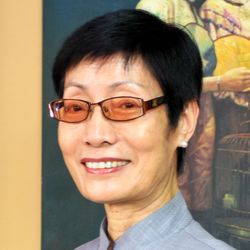
Official Title: Head of the Department of Catholic Studies in Chinese | Coordinator of the Professional Certificate for Religious Education Teachers | Emeritus Professor
Faculty:
宗教研究及哲學學院
電郵: anna.chan@usj.edu.mo
Short Bio
1985 Master (S.T.L.) (Spirituality), Pontificia Studiorum Universitas Salesiana Romae. 1986 Master (S.T.L.) (Sacred Liturgy), Pontificia Athenaeum Anselmianum Facultas Liturgiae seu Pontificium Institutum Liturgicum Romae. 1993 Doctorate (S.T.D.) (Sacred Liturgy), Pontificia Athenaeum Anselmianum Facultas Liturgiae seu Pontificium Institutum Liturgicum Romae. 2008 Diploma (Archivistica), Scuola Vaticana di Paleografia, Diplomatica e Archivistica.
Her teaching experience includes: From 1996 to 2007, she taught theology at the Holy Spirit Seminary College of Theology and Philosophy of Hong Kong, and she was appointed as one of the members of the editorial board of the Theology Annual of the College during the same period. She was invited also to teach in the various seminaries in Mainland China from 1998 to 2006. She joined the University of Saint Joseph in January 2011 and held the position of Vice-Rector of the University from October 2011 to September 2014, when the mandate terminated. At present she is teaching theology in the Faculty of Religious Studies.
Publications
Books
A. Kai Yung Chan-A.M. Triacca-A. Pistoia (a cura di), Ephemerides Liturgicae, Indice
Generale 1887-1986 (Roma: Edizioni Liturgiche, 1989).
Anna Kai Yung Chan, Liturgical Spirituality and Christian community (Hong Kong: Kong
Kong Diocesan Liturgy Commission, 1989).
Anna Kai Yung Chan, Il Padre Nostro nei principali commenti patristici e il suo uso nella
Liturgia latina = Thesis ad Lauream no 181, Dissertatio ad doctoratum Sacrae Liturgiae assequendum in Pontificio Instituto Liturgico (Romae: 1993).
Articles
Articles published in books
Anna Kai-Yung CHAN, «Worship of the Catholic Church. A Brief Introduction to the
Liturgical Tradition of the Catholic Church», in Christian Worship Revisited = Faith and Life
Series 3 (Hong Kong: Hong Kong Christian Institute, 1999 revised edition) 68-160
Anna Kai Yung Chan. «Participation in the Liturgy», in Handbook for Liturgical Studies, Volume II:
Fundamental Liturgy. Edited by Anscar J. Chupungco (Collegeville, Minnesota: The Liturgical Press, 1998) 145-159.
Anna Kai Yung Chan. «Restricted View on “Beauty” as Revealed in the Scripture», in
Philarchisophia and Classics III, edited by Yang Xi (Beijing: Social Sciences Academic Press, 2006) 300-316.
Articles published in periodicals
Anna Kai Yung Chan, «Report on the International Congress on the Reform of Gregory VII
and Europe», Collectanea Theologica Universitatis Fujen 66 (1986) 569-576.
Anna Kai Yung Chan, «Il rito della consegna del Padre Nostro (Mt 6,9-13) nei Sermoni
LVI-LIX di Sant‘Agostino di Ippona», Ecclesia Orans 10 (1993) 287-312.
Anna Kai Yung Chan, «A Brief explanation of the Liturgy of the Word», Kung Kao Po (29
March-17 May 1996) in 7 parts.
Anna Kai Yung Chan, «The motive of the participation of the faithful in the liturgy, and their
role in the liturgy», Kung Kao Po (12 July-2 August 1996) in 4 parts.
Anna Kai Yung Chan, «St Augustine‘s Views on Sexuality», Spirit 32 (1997) 11-28.
Anna Kai Yung Chan, «The Transmission and Reception of Faith and Theological Method»,
Theology Annual 19 (1998) 13-51.
Anna Kai Yung Chan, «The Holy Spirit - Source of the Church‘s Liturgical Dynamism»,
Spirit 36 (1998) 54-62.
Anna Kai Yung Chan, «God The Father in St. Augustine‘s Our Father», Spirit 39 (1998)
34-46.
Anna Kai Yung Chan, «Faith, theology and the Magisterium of the Church», Kung Kao Po
(27 September-8 November 1998) in 7 parts.
Anna Kai Yung Chan, «Contemporary Trends in Catholic Theology: Liturgy», Spirit 41
(1999) 60-74.
Anna Kai Yung Chan, «The Necessity of inculturation from the perspective of modernization
and globalization», Theology Annual 21 (2000) 105-115.
Anna Kai Yung Chan, «The Third Command “Remember to keep Holy the Lord’s Day”»,
Spirit 46 (2000) 12-29.
Anna Kai Yung Chan, «Perspectives for the inculturation of Liturgy in the Church in
China», Theology Annual 22 (2001) 1-81.
Anna Kai Yung Chan, «Evangelization, theology and some of the contemporary thinking», in
Vineyard 29 (2001) 23-28 [Newsletter of the Student Association of Sheshan Seminary].
Anna Kai Yung Chan, «Forgiveness and Hope: A Liturgical Perspective”, Spirit 57 (2003)
19-30.
Anna Kai Yung Chan, «The Popes commemorated in the First Eucharistic Prayer [The
Roman Canon] », Spirit 62 (2004) 24-38.
Anna Kai Yung Chan, «Vatican II and the Liturgy», Spirit 68 (2006) 90-124.
Anna Kai-Yung CHAN, «A Brief Introduction to the Liturgy of the Hours (Divine Office)»,
Spirituality and the Modern Metropolis, Theology & Life, Annual Theological Journal 29 (2006) 17-35.
Anna Kai Yung Chan, «Scripture and Liturgical Celebrations», Spirit 76 (2008) 53-83.
Anna Kai Yung Chan, «Report of the XIII Ordinary General Assembly of The Synod of
Bishops» written in Chinese and published on Aurora, Serviço Noticioso No. 5 (03/02/2013), and in English which was translated into Portuguese and transformed into an interview by the Editors (without informing the author of the Report) with the title «Macau no Vaticano» published on O Clarim, Semanario Católic de Macau No. 37 (08/02/2013).
Anna Kai Yung Chan, «From the Month of All Souls in the purgatory to introduce the
concept of the Chinese’s memorial ceremony to their ancestors I», O Clarim (14 November 2014 Chinese edition) p. 6.
Anna Kai Yung Chan, «From the Month of All Souls in the purgatory to introduce the
concept of the Chinese’s memorial ceremony to their ancestors II», O Clarim (21 November 2014 Chinese edition) p. 6.
Anna Kai Yung Chan, «From the Month of All Souls in the purgatory to introduce the
concept of the Chinese’s memorial ceremony to their ancestors III», O Clarim (28 November 2014 Chinese edition) p. 6.
Anna Kai Yung Chan, «The significant meaning of Advent and Christmas I», O Clarim (12
December 2014 Chinese edition) p.6.
Anna Kai Yung Chan, «The significant meaning of Advent and Christmas II», O Clarim (19
December 2014 Chinese edition) p. 6.
Anna Kai Yung Chan, «The inspired feeling from the pilgrimage journey to Shang Chuen
Island I», O Clarim (19 December 2014 Chinese edition) p. 7.
Anna Kai Yung Chan, «The inspired feeling from the pilgrimage journey to Shang Chuen
Island II», O Clarim (09 January 2015 Chinese edition) p. 9.
Translation
方奉天原著,陳繼容編譯,《信仰小引導》 光啟叢書,上海,天主教上海教區,光啟社
1997 [Original title: Bruno Forte, Piccola introduzione alla fede (Milano, Edizioni Paoline 1992)].
Modules
Year 2 Bachelor
Liturgy is not a branch of aesthetics; it is the root of theology. We will explore the proposition that lex orandi establishes les credendi in three ways. First, we will examine the purpose and method of liturgical theology as expressed by various authors, but especially Schmemann, Kavanagh, and Taft. Second, we will examine the difference this approach makes when treating traditional theological subjects (e.g. worship, ecclesiology, eschatology, sacrifice, the relationship between church and world, etc.). Third, we will especially consider how liturgical theology bears on sacramentology. This course will be useful to students for a coherent understanding of sacraments expressing the life of the Church.
Alternative Description:
Liturgy is not a branch of aesthetics; it is the root of theology. We will explore the proposition that lex orandi establishes les credendi in three ways. First, we will examine the purpose and method of liturgical theology as expressed by various authors, but especially Schmemann, Kavanagh, and Taft. Second, we will examine the difference this approach makes when treating traditional theological subjects (e.g. worship, ecclesiology, eschatology, sacrifice, the relationship between church and world, etc.). Third, we will especially consider how liturgical theology bears on sacramentology. This course will be useful to students for a coherent understanding of sacraments expressing the life of the Church.
Alternative Description:
Liturgy is not a branch of aesthetics; it is the root of theology. We will explore the proposition that lex orandi establishes les credendi in three ways. First, we will examine the purpose and method of liturgical theology as expressed by various authors, but especially Schmemann, Kavanagh, and Taft. Second, we will examine the difference this approach makes when treating traditional theological subjects (e.g. worship, ecclesiology, eschatology, sacrifice, the relationship between church and world, etc.). Third, we will especially consider how liturgical theology bears on sacramentology. This course will be useful to students for a coherent understanding of sacraments expressing the life of the Church. This course is a basic introduction to the systems of beliefs, rituals and practices of the Christian community, with a focus on the varieties of scriptural interpretation, historical experience, doctrine, and behavior. A primary goal will be to attempt to understand each tradition from the point of view of those who are a part of that expression of Christianity.
Alternative Description:
This course is a basic introduction to the systems of beliefs, rituals and practices of the Christian community, with a focus on the varieties of scriptural interpretation, historical experience, doctrine, and behavior. A primary goal will be to attempt to understand each tradition from the point of view of those who are a part of that expression of Christianity.
Participants will explore the foundation of Christian ethics, with a concentration on these and similar questions: On what basis do people decide how to make moral choices? Why do we take the moral stands we do on issues facing the churches and society? Do Christians have different ways of making decisions than people from other religious or secular traditions? The course examines philosophical, sociological and theological perspectives to these questions.
Alternative Description:
Introduction of mayor ethical systems in philosophy and moral theology. Fundamental concepts of ethical reasoning and of morality are discussed and reflected on key challenges of life, for example, questions at the beginning and end of life, gender relations, sexual ethics, bioethics, and other selected issues of professional and applied ethics. The study of ethics and moral theology goes beyond considerations of right and wrong conduct, just and unjust behavior and institutions, to encompass inquiry into happiness, the relevance of values and faith in moral decision making and in what constitutes “the good life” worth living in view of the ultimate meaning of life as expressed in the catholic faith tradition.
Alternative Description:
Participants will explore the foundation of Christian ethics, with a concentration on these and similar questions: On what basis do people decide how to make moral choices? Why do we take the moral stands we do on issues facing the churches and society? Do Christians have different ways of making decisions than people from other religious or secular traditions? The course examines philosophical, sociological and theological perspectives to these questions.
Year 4 Bachelor
This course will explore the history of Christianity in China, with special emphasis on the various missionary strategies. Special emphasis will be placed on the successful inculturation experiments in relation to the more traditional acculturating efforts toward local populations.
Alternative Description:
The history of the relationship between western and far east cultures can be seen through the way that Christianity had been received in China. This course establishes different periods in the reception and understanding of Christianity in China, from the first Nestorian communities till the complex identities of Christianity in contemporary China.
Alternative Description:
This course will explore the history of Christianity in China, with special emphasis on the various missionary strategies. Special emphasis will be placed on the successful inculturation experiments in relation to the more traditional acculturating efforts toward local populations.
Alternative Description:
This course will explore the history of Christianity in China, with special emphasis on the various missionary strategies. Special emphasis will be placed on the successful inculturation experiments in relation to the more traditional acculturating efforts toward local populations.The focus of this Marian Theology course is the Scriptural Christocentric and Ecclesiotypical Mariology emerging from Vatican II. This course will also study the contribution of the Fathers of the Church, and the rich legacy of some Marian writers prior to Vatican II, because an appreciation of the past is indispensable for an understanding of Marian Theology today. Future directions in Mariology will also be explored.
Alternative Description:
The focus of this Marian Theology course is the Scriptural Christocentric and Ecclesiotypical Mariology emerging from Vatican II. This course will also study the contribution of the Fathers of the Church, and the rich legacy of some Marian writers prior to Vatican II, because an appreciation of the past is indispensable for an understanding of Marian Theology today. Future directions in Mariology will also be explored.
Alternative Description:
The focus of this Marian Theology course is the Scriptural Christocentric and Ecclesiotypical Mariology emerging from Vatican II. This course will also study the contribution of the Fathers of the Church, and the rich legacy of some Marian writers prior to Vatican II, because an appreciation of the past is indispensable for an understanding of Marian Theology today. Future directions in Mariology will also be explored. Music has long played an important role in Christian liturgy as an artistic expression of the Church’s prayer and theology. Part I of this course will survey the historical development of Christian liturgy and its theological interpretation from the New Testament period forward, focusing in particular on the role of music and theology of music in liturgy. Part II will concentrate on the use of music in liturgy today, studying various official Church documents on music from Vatican II forward (including: Sacrosanctum Concilium, Musicam Sacram, Music in Catholic worship, and Liturgical Music Today), and drawing forth principles for determining theologically and pastorally what are the functions and appropriate uses of music in liturgy today.
Alternative Description:
Music has long played an important role in Christian liturgy as an artistic expression of the Church’s prayer and theology. Part I of this course will survey the historical development of Christian liturgy and its theological interpretation from the New Testament period forward, focusing in particular on the role of music and theology of music in liturgy. Part II will concentrate on the use of music in liturgy today, studying various official Church documents on music from Vatican II forward (including: Sacrosanctum Concilium, Musicam Sacram, Music in Catholic worship, and Liturgical Music Today), and drawing forth principles for determining theologically and pastorally what are the functions and appropriate uses of music in liturgy today. Year 5 Bachelor
As an integral part of the Licenciate studies, all undergraduate students at USJ are required to prepare and present a portfolio of their work. The portfolio is assembled over the entire duration of their undergraduate studies, and is to consist of selected pieces of work that they have produced during their studies. A student’s portfolio may contain examples of assignment work, tests and examination answer scripts, presentations and project reports, and other work done by the student during his or her studies.
Alternative Description:
As an integral part of the Licenciate studies, all undergraduate students at USJ are required to prepare and present a portfolio of their work. The portfolio is assembled over the entire duration of their undergraduate studies, and is to consist of selected pieces of work that they have produced during their studies. A student’s portfolio may contain examples of assignment work, tests and examination answer scripts, presentations and project reports, and other work done by the student during his or her studies. This course will explore the Sacraments of Reconciliation and of Anointing of the Sick. Historical, theological, canonical, liturgical and pastoral dimensions are given appropriate attention so as to prepare the future priest celebrants.
Year 1 Diploma
Year 1 Doctorate
This module aims to introduce participants to key elements of doctoral research in the broad sense of an Academic framework. It focuses on providing an understanding of the research support Mechanisms at USJ and in overviews of the main research specialisation fields within the University of Saint Joseph, namely Business Administration; Education; Global Studies; Government Studies; History; Information Systems; Psychology; Religious Studies; Science. The course also provides an opportunity for the students to present and discuss their own work in a seminar environment.
This Module provides an initial experience of supervised research work where students will work with their intended supervisor in a collaborative tutorial model that resembles the practice of Thesis Supervision. During the Module the intended supervisor will guide the student trough multiple meetings (up to 15) during a full academic year The students will conduct autonomous research that should result in a preliminary literature review, research contextualisation and a thesis proposal completely finished and prepared to be submitted to the Foundation Year Final thesis proposal review and assessment instances.
Year 0 LifeLong Learning
Man and Faith - How does religious faith talk about life