
Call for Application: International Training Workshop/Symposium | “Decoding”Western Sources on the History of East-West Encounters & Christianity
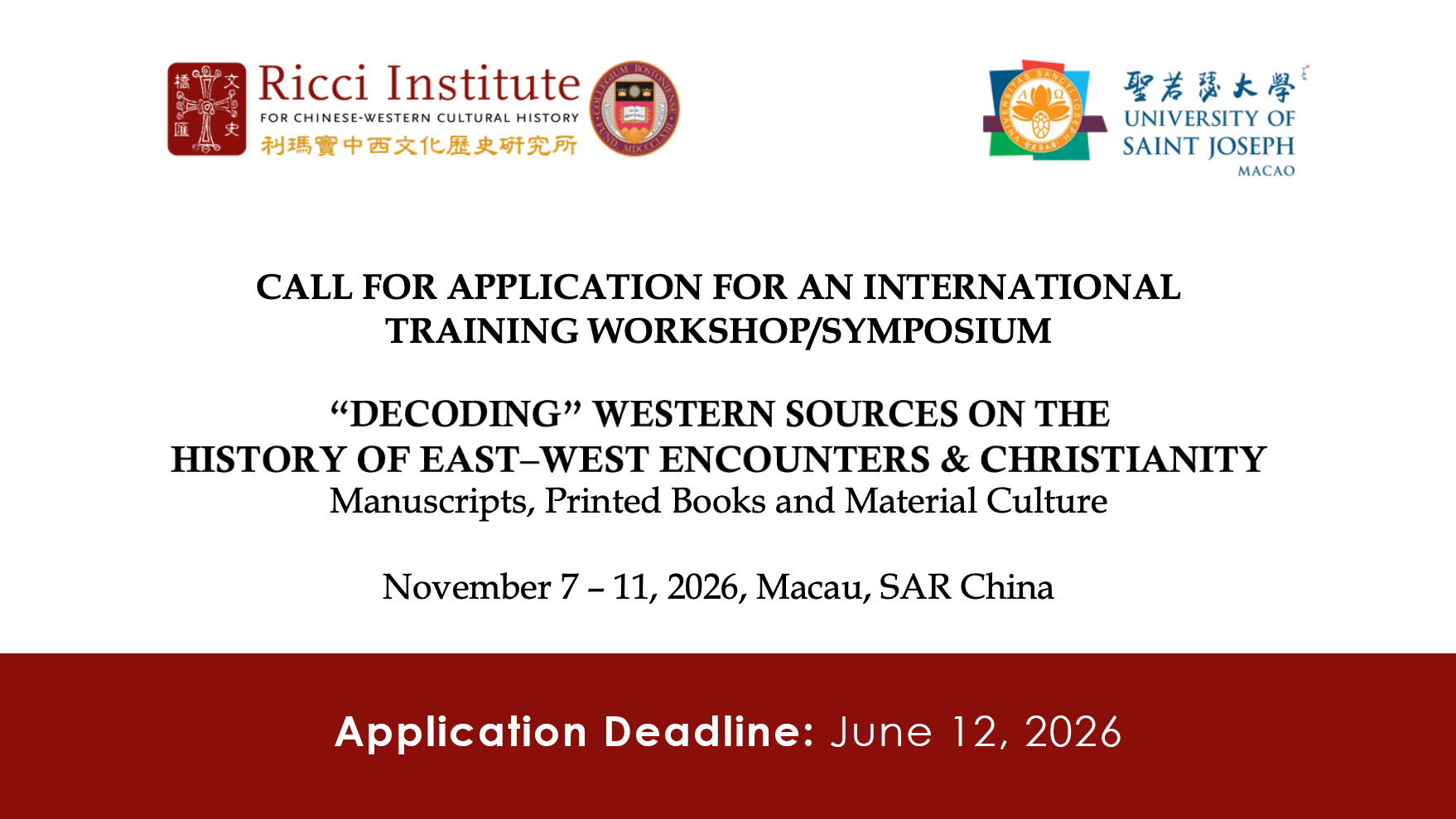
Call for Application: International Training Workshop/Symposium | "Decoding"Western Sources on the History of East-West Encounters & Christianity
21
May
21/05/2026
USJ Macao and the Ricci Institute for Chinese-Western Cultural History at Boston College is jointly organising an international training workshop and symposium in Macao from November 7–11, 2026.
This international training workshop and symposium, co-sponsored by Ricci Institute for Chinese-Western Cultural History at Boston College and the University of Saint Joseph in Macau, will take place in Macau SAR, China, from November 7–11, 2026. It focuses on the “decoding” of Western-language manuscripts, printed books, and material artifacts related to East–West encounters and Christianity in East Asia (16th– 18th centuries, (China, Japan, Korea, and Vietnam). Combining public lectures with hands-on training sessions, the program equips participants to critically read and interpret complex primary sources. Designed for doctoral candidates, postdoctoral scholars, and junior faculty based in East Asia, it offers intensive methodological training in historical and textual analysis. The working language of the program is English.
Details:
Event Date: November 7 – 11, 2026
Location: University of Saint Joseph, Macau SAR
Co-organized by:
- The Ricci Institute for Chinese-Western Cultural History at Boston College, U.S.A.
- University of Saint Joseph, Macau SAR, China
Textual Culture: The reading of Western-language manuscripts and rare books produced in the sixteenth to eighteenth centuries poses many challenges, including archaic vocabulary and grammar, inconsistencies in spelling, unfamiliar conventions for abbreviations of letters and/or entire words, unfamiliar intertextual references, the difficulty of distinguishing between autographs and fair copies, the cross-contamination of texts and the introduction of textual errors, additions, and omissions as a result of copying, editing, and censorship, among others. Moreover, in the case of printed sources, the diversity of font types, the inclusion of prefaces, dedicatory letters, and interpolated interpretations of the original texts, translated and/or abridged editions, as well as other features of printed works (e.g., colophons, errata corrige, and physical binding) all require study and analysis.
Material Culture: Recent scholarship has also begun to pay particular attention to non- textual sources in the study of history, in this case more specifically, the material culture that is an expression of the encounter between Christianity and East Asia. Works of art that are “hybrid” in style or otherwise influenced by Western models, produced either
in Europe for use in East Asia or in East Asia for local communities, by European and/or Asian artists, can be equally difficult to “decipher” and “interpret”. Other historical artifacts (e.g., liturgical objects and vestments, tea bowls, Buddhist objects secretly adopted for Christian worship, etc. …) also reflect specific historical events, contexts, and cultural developments.
The program will consist of two components, a symposium and a workshop. The symposium will include lectures on relevant designated topics by experts in the field and open to the public. Registration to attend the symposium is required and will be announced in September 2026. At the same time, the workshop will serve as “hands on” training for Asian scholars who need to develop further their ability to read and interpret these primary sources for their doctoral studies or to undertake new research projects. Space is limited and participation in the workshop will be evaluated through this formal application process. Accepted attendees will take part in training/decoding sessions led by experts in the above fields.
Requirements:
- 1) Current doctoral candidates, postdoctoral scholars, and junior faculty members in higher educational and research institutions in East Asia (regardless of citizenship).
- 2) Demonstrated research and/or teaching experience in the study of Christianity in East Asia in philosophy, history, intellectual history, art, language, science, religious studies, and other subjects in humanities from the 16th to the
18th centuries, especially in utilizing original Western language manuscripts (NOT translations) in teaching and research; - 3) Reading proficiency in at least one European language besides English, such as Latin, French, Italian, Spanish or Portuguese, etc.;
Documents to be included with applications:
1) A most recent Curriculum Vitae in English;
2) A research synopsis (5 pages) in English that:
a) Briefly explains the applicant’s teaching and/or research experience and illustrates how primary source materials in other European language(s) during the 16th – 18th centuries have been employed, including major problems/difficulties that the applicant has encountered;
b) Cites one example, such as a letter, report, diary in a European language other than English produced in the 16th – 18th centuries that has been studied by the applicant with a brief interpretation. Please attach a copy of the manuscript (1-2 pages) as a supporting document; or a syllabus that the applicant has used to teach a class that involves the study of primary manuscript sources during the above historical period with examples;
c) Explains as concretely as possible how a workshop like the current one may benefit the applicant’s teaching and research in the future;
d) Briefly shares a tentative plan in teaching and/or research that will involve additional/new manuscripts from the 16th – 18th centuries in the future.
3) Two up-to-date recommendation letters in English from scholars who are
familiar with the work of the applicant in relation to the use of primary source manuscripts.
Expenses
The Ricci Institute at Boston College and the University of Saint Joseph will administer workshop-related expenses for successful applicants as follows:
1) Transportation
- Accepted applicants from the People’s Republic of China (including Mainland China, Hong Kong, and Macau) are expected to cover their own travel costs from their home city to Macau.
- A limited number of travel scholarships are available for accepted applicants from East Asia outside the PRC. These awards may cover economy-class airfare from the applicant’s home city/country of residence, as well as local public transportation between the home airport and the workshop venue. Applicants are encouraged to seek partial funding support from their home institutions, where possible; the workshop co-sponsors may supplement such support, subject to availability, to help offset remaining eligible expenses.
2) Lodging and Meals
Accommodation and most meals in Macau, from the evening of November 7 through the morning of November 11, will be provided by the workshop co- sponsors.
Note:
Accepted applicants from Mainland China are encouraged to travel by high-speed rail to Zhuhai for ease of access to the workshop venue.
All approved expenses will be reimbursed upon submission of original, itemized receipts, in accordance with the travel policies of Boston College and the University of Saint Joseph. Personal and incidental expenses (e.g., travel insurance, mobile phone/SIM cards, data plans, and similar costs) are not eligible for reimbursement.
Medical Insurance
All participants are responsible to arrange and pay for their own valid medical insurance for the duration of their stay in Macau, China. The pre-purchase of medical insurance (before arriving in Macau) for the duration of a participant’s stay is mandatory.
Visa
If you are required to apply for a visa or travel permit to enter Macau, your workshop participation award letter will be considered a formal invitation letter for you to apply for your visa or travel permit.
Deadline
All required documents should be in English and submitted via email no later than June 12, 2026 to Prof. Thomas Cai at: thomas.cai@usj.edu.mo, with the subject: “Application for the 2026 Macau International Workshop”. Letters from the recommenders must be sent directly to the above email address by the same deadline.
Inquiries regarding the application and the workshop should also be sent to: Dr. Xiaoxin Wu at: xiaoxin.wu.2@bc.edu. Not applications will be accepted at this email address.
Application results will be announced by mid-July 2026.
For more information about the Ricci Institute, Boston College, please visit: https://www.bc.edu/ricci


-60x50.jpg)