
Doctoral Forum in Religious Studies and Philosophy 2026
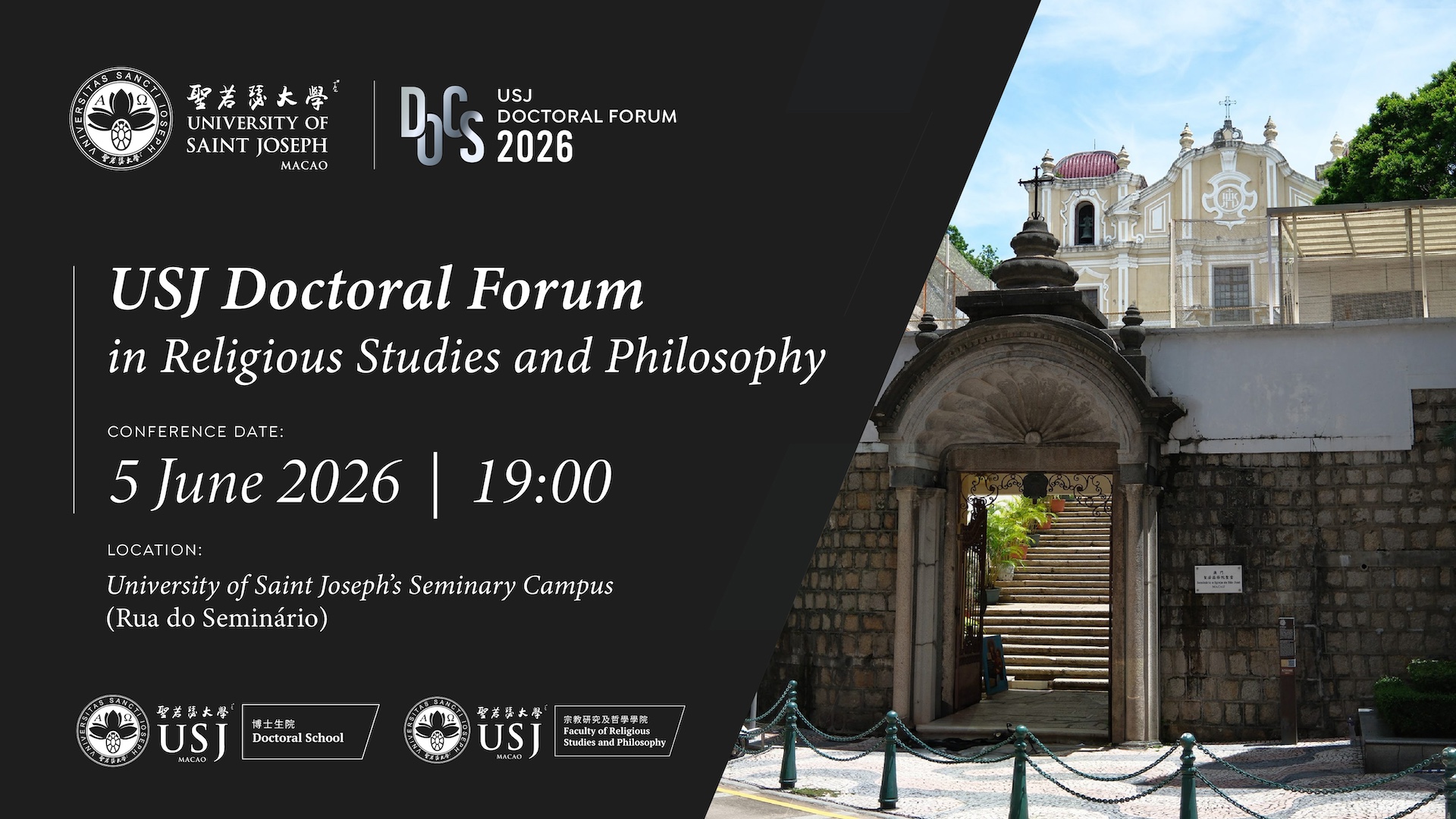
Doctoral Forum in Religious Studies and Philosophy 2026
05
Jun
The USJ Doctoral School and the Faculty of Religious Studies and Philosophy are organising a Doctoral Forum in the study/research area of Religious Studies and Philosophy on 5 of June 2026, in the Conference Room of the Seminary Campus.
The USJ Doctoral School and the Faculty of Religious Studies and Philosophy are organising a Doctoral Forum in the study/research area of Religious Studies and Philosophy on 5 of June 2026, in the Multi-function Room of the USJ Seminary Campus.
Details:
Date: Friday, 5 June 2026
Time: 19:00 – 22:00 (GMT+8)
Location: Multi-function Room in the Seminary Campus of University of Saint Joseph | Rua do Seminário (Gate located at the Rua do Seminário leads to the Seminary campus, and the door on the right side of the church gives access to the Faculty of Religious Studies and Philosophy)
Language: English
Organised by USJ’s Doctoral School, and USJ’s Faculty of Religious Studies and Philosophy
Meeting ID: 889 2386 5667 Passcode: 226296
*This is a free event and open to the general public.
Programme:
19:00 – 19:10 | Opening Session and Welcome address by:
- Dean of the Doctoral School, Professor Adérito Fernandes-Marcos
- Dean of the Faculty of Religious Studies and Philosophy, Fr. Cyril Jerome Jr. Law
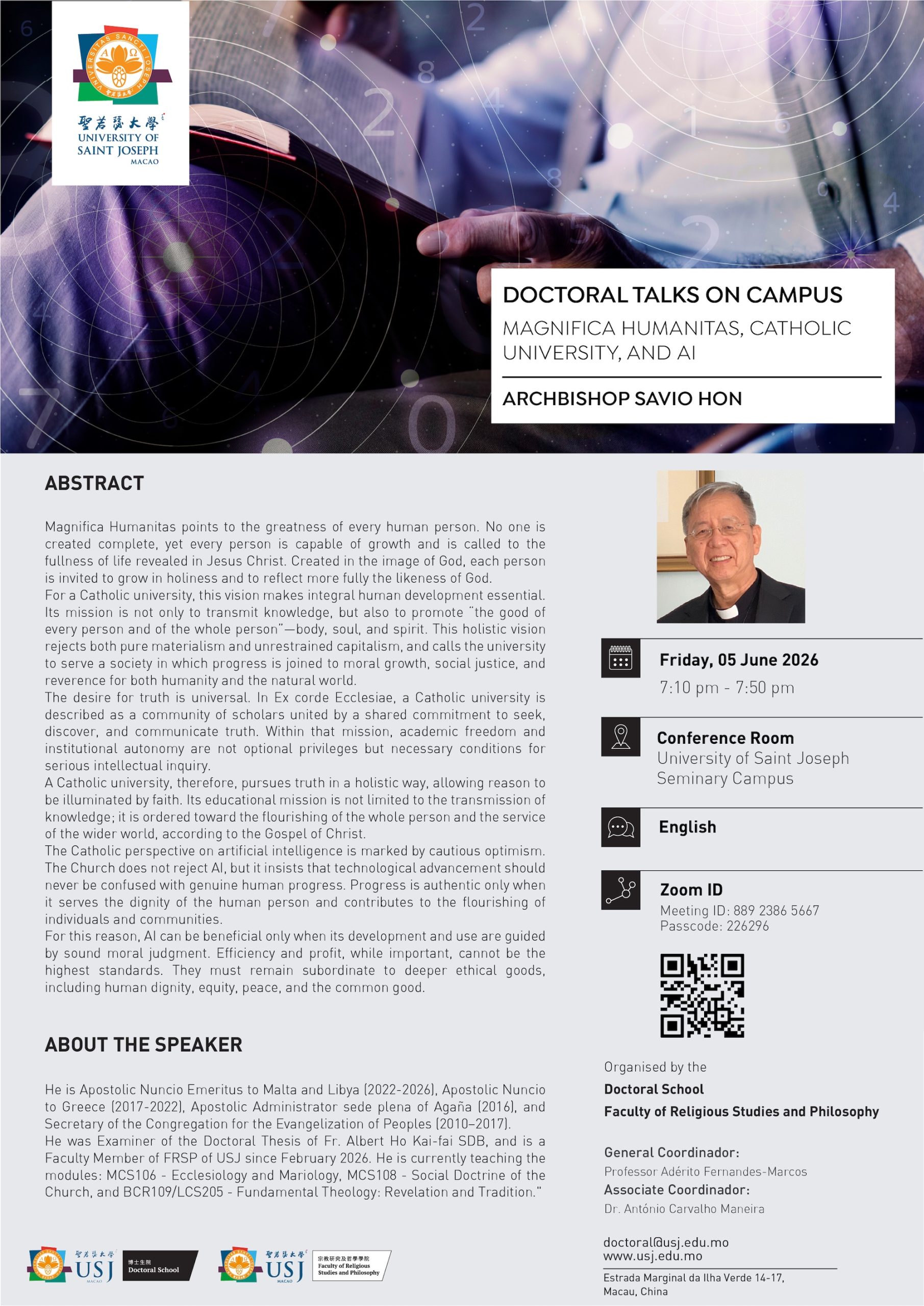
19:00 – 19:50 | Doctoral Talk by Archbishop Savio Hon
Magnifica Humanitas, Catholic University, and AI
Speaker: Archbishop Savio Hon
He is Apostolic Nuncio Emeritus to Malta and Libya (2022-2026), Apostolic Nuncio to Greece (2017-2022), Apostolic Administrator sede plena of Agaña (2016), and Secretary of the Congregation for the Evangelization of Peoples (2010–2017). He was Examiner of the Doctoral Thesis of Fr. Albert Ho Kai-fai SDB, and is a Faculty Member of FRSP of USJ since February 2026. He is currently teaching the modules: MCS106 – Ecclesiology and Mariology, MCS108 – Social Doctrine of the Church, and BCR109/LCS205 – Fundamental Theology: Revelation and Tradition.”
Abstract:
Magnifica Humanitas points to the greatness of every human person. No one is created complete, yet every person is capable of growth and is called to the fullness of life revealed in Jesus Christ. Created in the image of God, each person is invited to grow in holiness and to reflect more fully the likeness of God.
For a Catholic university, this vision makes integral human development essential. Its mission is not only to transmit knowledge, but also to promote “the good of every person and of the whole person”—body, soul, and spirit. This holistic vision rejects both pure materialism and unrestrained capitalism, and calls the university to serve a society in which progress is joined to moral growth, social justice, and reverence for both humanity and the natural world.
The desire for truth is universal. In Ex corde Ecclesiae, a Catholic university is described as a community of scholars united by a shared commitment to seek, discover, and communicate truth. Within that mission, academic freedom and institutional autonomy are not optional privileges but necessary conditions for serious intellectual inquiry.
A Catholic university, therefore, pursues truth in a holistic way, allowing reason to be illuminated by faith. Its educational mission is not limited to the transmission of knowledge; it is ordered toward the flourishing of the whole person and the service of the wider world, according to the Gospel of Christ.
The Catholic perspective on artificial intelligence is marked by cautious optimism. The Church does not reject AI, but it insists that technological advancement should never be confused with genuine human progress. Progress is authentic only when it serves the dignity of the human person and contributes to the flourishing of individuals and communities.
For this reason, AI can be beneficial only when its development and use are guided by sound moral judgment. Efficiency and profit, while important, cannot be the highest standards. They must remain subordinate to deeper ethical goods, including human dignity, equity, peace, and the common good.
19:50 | Refreshments Break
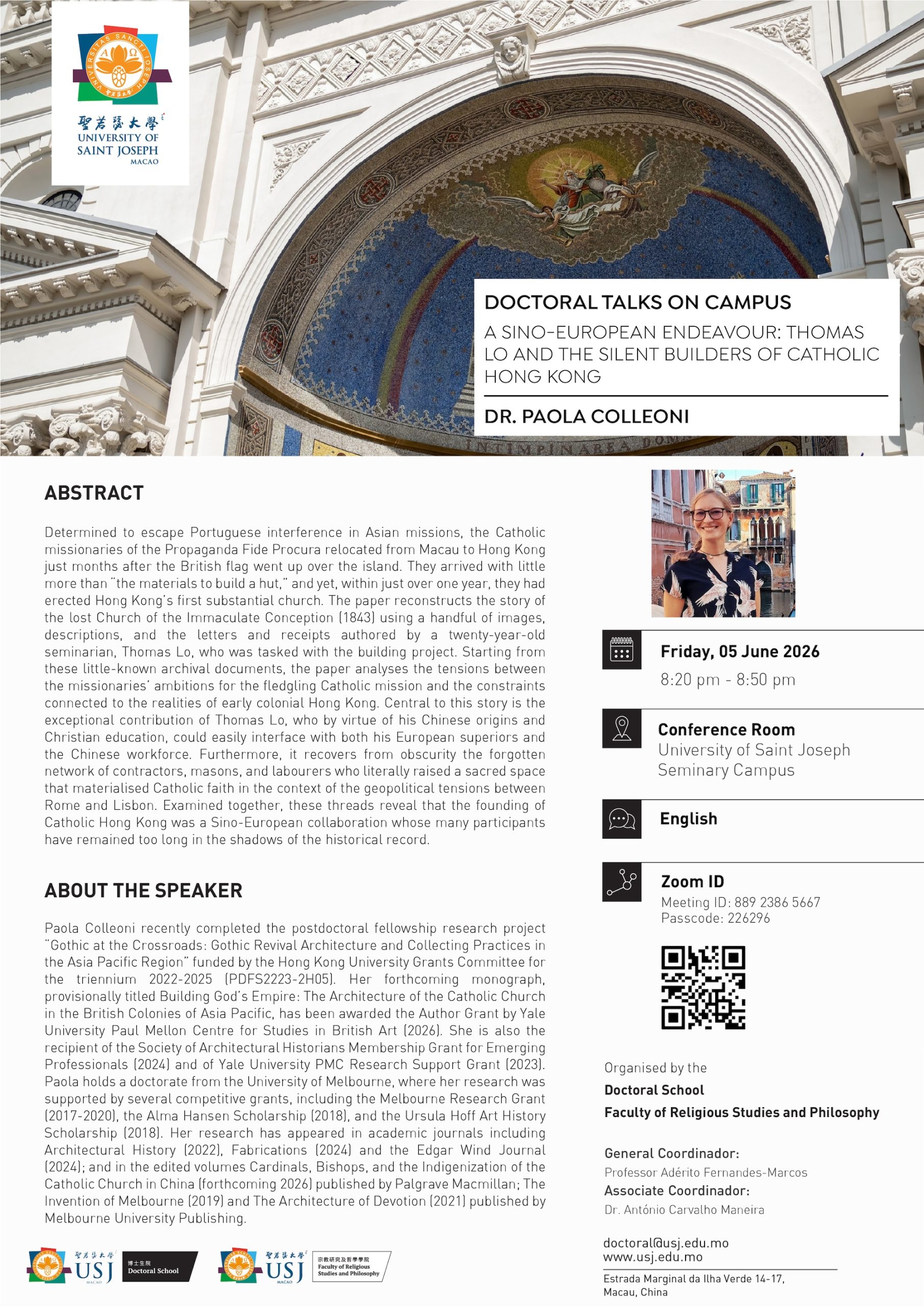
20:20 – 21:50 | Doctoral Talk by Dr. Paola Colleoni
A Sino-European Endeavour: Thomas Lo and the Silent Builders of Catholic Hong Kong
Speaker: Paola Colleoni
Paola Colleoni recently completed the postdoctoral fellowship research project “Gothic at the Crossroads: Gothic Revival Architecture and Collecting Practices in the Asia Pacific Region” funded by the Hong Kong University Grants Committee for the triennium 2022-2025 (PDFS2223-2H05). Her forthcoming monograph, provisionally titled Building God’s Empire: The Architecture of the Catholic Church in the British Colonies of Asia Pacific, has been awarded the Author Grant by Yale University Paul Mellon Centre for Studies in British Art (2026). She is also the recipient of the Society of Architectural Historians Membership Grant for Emerging Professionals (2024) and of Yale University PMC Research Support Grant (2023). Paola holds a doctorate from the University of Melbourne, where her research was supported by several competitive grants, including the Melbourne Research Grant (2017-2020), the Alma Hansen Scholarship (2018), and the Ursula Hoff Art History Scholarship (2018). Her research has appeared in academic journals including Architectural History (2022), Fabrications (2024) and the Edgar Wind Journal (2024); and in the edited volumes Cardinals, Bishops, and the Indigenization of the Catholic Church in China (forthcoming 2026) published by Palgrave Macmillan; The Invention of Melbourne (2019) and The Architecture of Devotion (2021) published by Melbourne University Publishing.
Abstract:
Determined to escape Portuguese interference in Asian missions, the Catholic missionaries of the Propaganda Fide Procura relocated from Macau to Hong Kong just months after the British flag went up over the island. They arrived with little more than “the materials to build a hut,” and yet, within just over one year, they had erected Hong Kong’s first substantial church. The paper reconstructs the story of the lost Church of the Immaculate Conception (1843) using a handful of images, descriptions, and the letters and receipts authored by a twenty-year-old seminarian, Thomas Lo, who was tasked with the building project. Starting from these little-known archival documents, the paper analyses the tensions between the missionaries’ ambitions for the fledgling Catholic mission and the constraints connected to the realities of early colonial Hong Kong. Central to this story is the exceptional contribution of Thomas Lo, who by virtue of his Chinese origins and Christian education, could easily interface with both his European superiors and the Chinese workforce. Furthermore, it recovers from obscurity the forgotten network of contractors, masons, and labourers who literally raised a sacred space that materialised Catholic faith in the context of the geopolitical tensions between Rome and Lisbon. Examined together, these threads reveal that the founding of Catholic Hong Kong was a Sino-European collaboration whose many participants have remained too long in the shadows of the historical record.
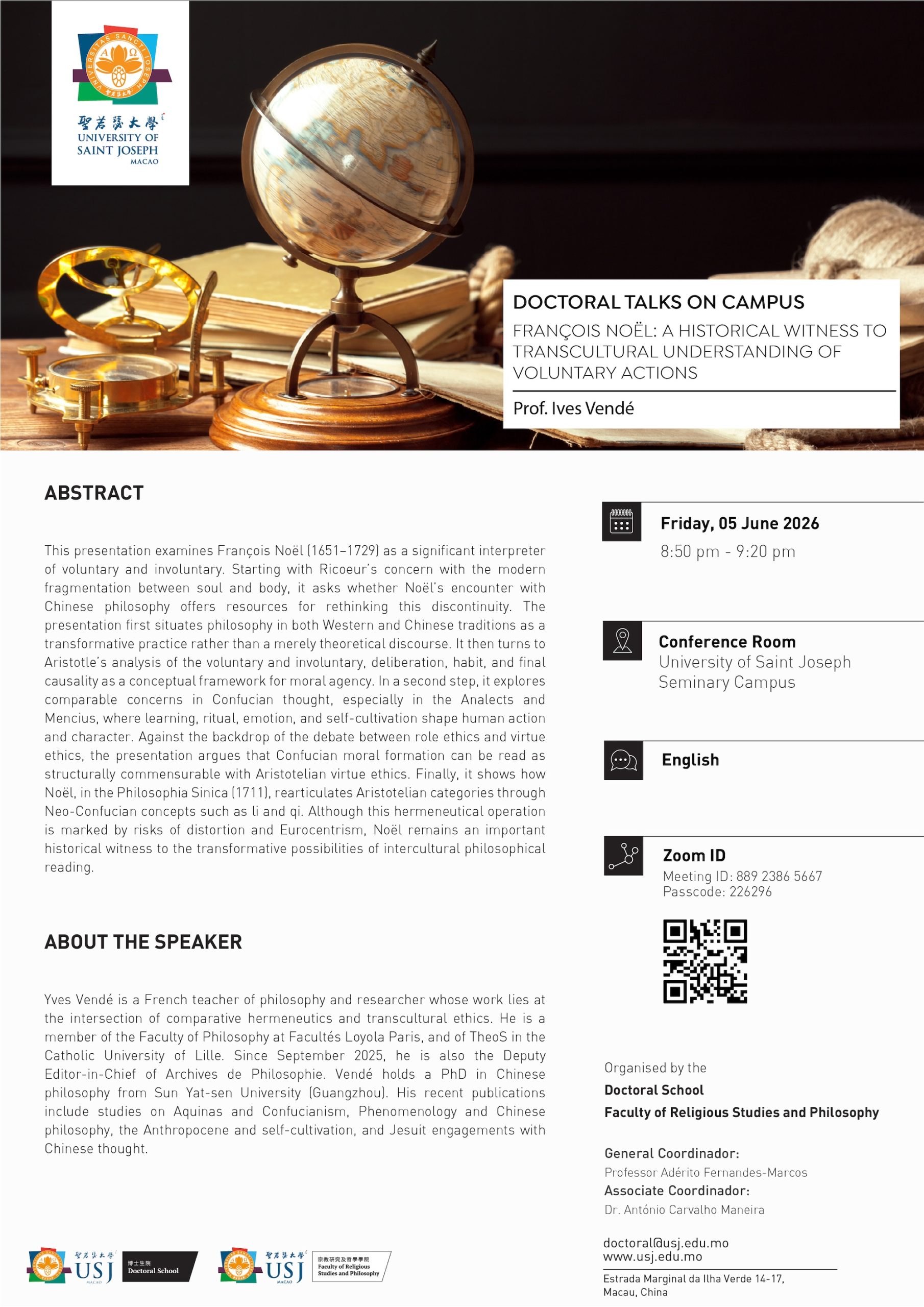
21:50 – 21:20 | Doctoral Talk by Prof. Ives Vendé
François Noël: A Historical Witness to Transcultural Understanding of Voluntary actions
Speaker: Yves Vendé
Yves Vendé is a French teacher of philosophy and researcher whose work lies at the intersection of comparative hermeneutics and transcultural ethics. He is a member of the Faculty of Philosophy at Facultés Loyola Paris, and of TheoS in the Catholic University of Lille. Since September 2025, he is also the Deputy Editor-in-Chief of Archives de Philosophie. Vendé holds a PhD in Chinese philosophy from Sun Yat-sen University (Guangzhou). His recent publications include studies on Aquinas and Confucianism, Phenomenology and Chinese philosophy, the Anthropocene and self-cultivation, and Jesuit engagements with Chinese thought.
Abstract:
This presentation examines François Noël (1651–1729) as a significant interpreter of voluntary and involuntary. Starting with Ricoeur’s concern with the modern fragmentation between soul and body, it asks whether Noël’s encounter with Chinese philosophy offers resources for rethinking this discontinuity. The presentation first situates philosophy in both Western and Chinese traditions as a transformative practice rather than a merely theoretical discourse. It then turns to Aristotle’s analysis of the voluntary and involuntary, deliberation, habit, and final causality as a conceptual framework for moral agency. In a second step, it explores comparable concerns in Confucian thought, especially in the Analects and Mencius, where learning, ritual, emotion, and self-cultivation shape human action and character. Against the backdrop of the debate between role ethics and virtue ethics, the presentation argues that Confucian moral formation can be read as structurally commensurable with Aristotelian virtue ethics. Finally, it shows how Noël, in the Philosophia Sinica (1711), rearticulates Aristotelian categories through Neo-Confucian concepts such as li and qi. Although this hermeneutical operation is marked by risks of distortion and Eurocentrism, Noël remains an important historical witness to the transformative possibilities of intercultural philosophical reading.
21:20 – 21:40 | Presentation by PhD Candidate: Magdalene Chan Si Weng
A Pastoral Analysis of the Catechetical Development with reference to Christian Initiation within the Chinese Catholic Community in Macau
PhD Candidate: CHAN Si Weng, Magdalene
Abstract: This research offers a systematic pastoral analysis of catechesis for Christian initiation within the Chinese Catholic community in Macau, spanning 450 years from the diocese’s establishment in 1576 to the present. Adopting a threefold approach—historical reconstruction, pastoral evaluation, and practical recommendations—the study first establishes a complete historical periodization based on major ecclesiastical and socio-political events. For each period, it examines catechetical content, teaching methods, means of transmission, and socio-pastoral context. Second, using the “Theological-Pastoral Discernment Method,” it systematically evaluates the effectiveness of catechetical measures and the faithful’s actual reception, identifying the logic and driving forces behind the evolution of catechesis. Third, drawing on historical experience and a critical analysis of the past decade (2016–2026), it proposes concrete, feasible pastoral recommendations for the Diocese of Macau.
Organisation: Doctoral School and the Faculty of Religious Studies and Philosophy
21:40 – 22:00 | Closing Remarks