
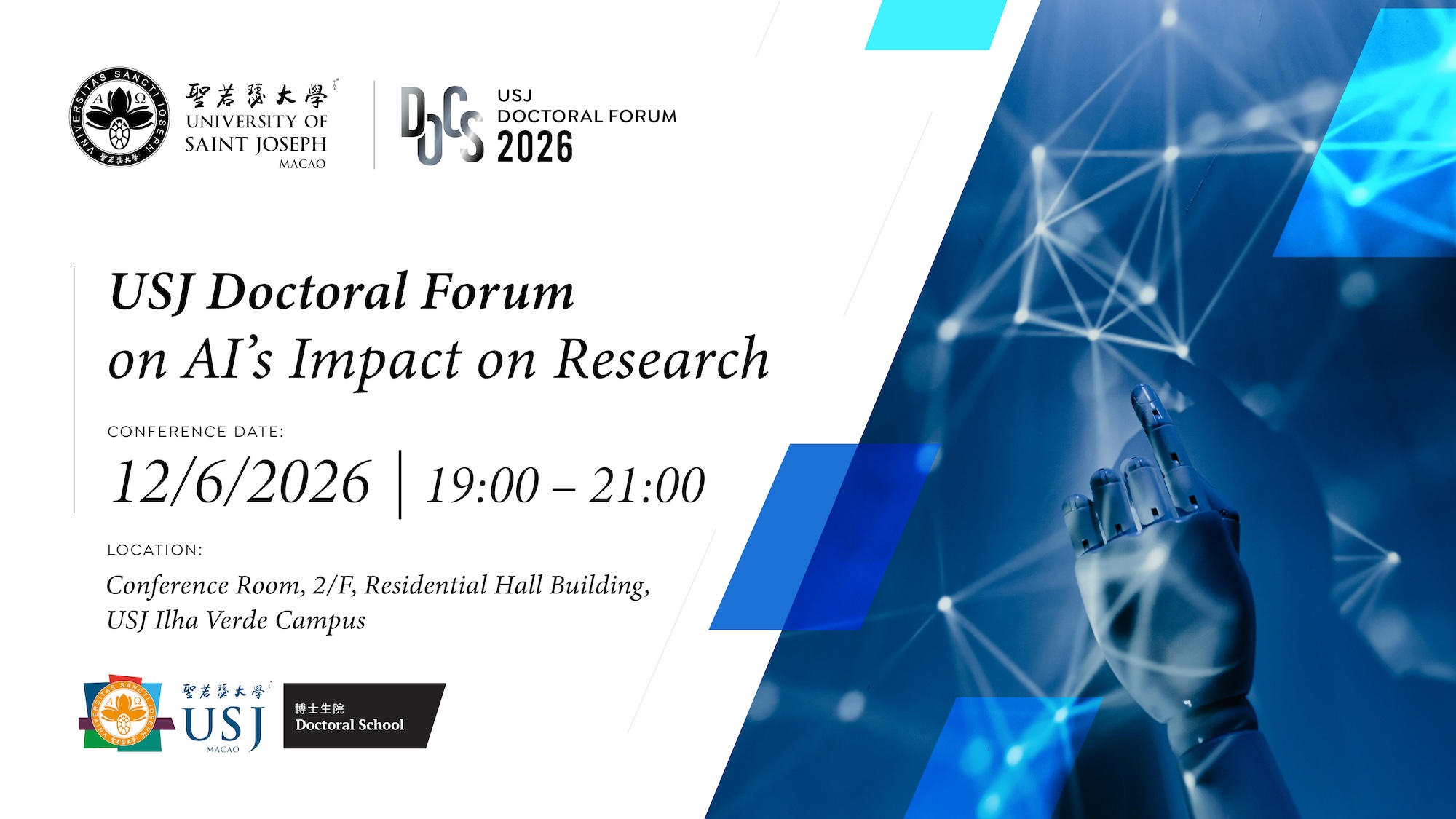
Doctoral Forum on AI’s Impact on Research 2026
Doctoral Forum on AI’s Impact on Research 2026
12
Jun
The USJ Doctoral School is organising a thematic Doctoral Forum “AI’s Impact on Research” on Friday 12 June, from 19:00 – 21:o0, in the USJ Conference Room.
The USJ Doctoral School is organising a thematic Doctoral Forum “AI’s Impact on Research” on Friday 12 June, from 19:00 – 21:o0, in the USJ Conference Room.
Programme Details:
Date: Friday, 12 June 2026
Time: 19:00 – 21:00
Location: Conference Room, 2/F, Residential Hall Building, USJ Ilha Verde Campus
Language: English
Organised by: Doctoral School
Contact: doctoral@usj.edu.mo
*Free event, open to the general public
Meeting ID: 889 2386 5667
Passcode: 226296
Schedule:
19:00-20:00 – Spring Doctoral Project Presentations
19:00-19:10 – Welcome Address by the Dean of the Doctoral School, Professor Adérito Fernandes-Marcos
19:10-19:25 – PhD Student: Shi Weixiong
19:25-19:40 – PhD Student: Lei Ka Ieng
19:40-19:55 – PhD Student: Nguyen Trong Nghia
20:00-21:00 – Panel: Navigating the Future: AI’s Impact on Research
Moderator: Prof. Alexandre Lobo, Vice-Rector for Research and Innovation at the University of Saint Joseph, Macao
Speakers:
- Dr Samar Shailendra, Melbourne Institute of Technology, Australia
- Professor Simon James Fong, Department of Computer and Information Science at the University of Macau, Macao
Panel: Navigating the Future: AI’s Impact on Research
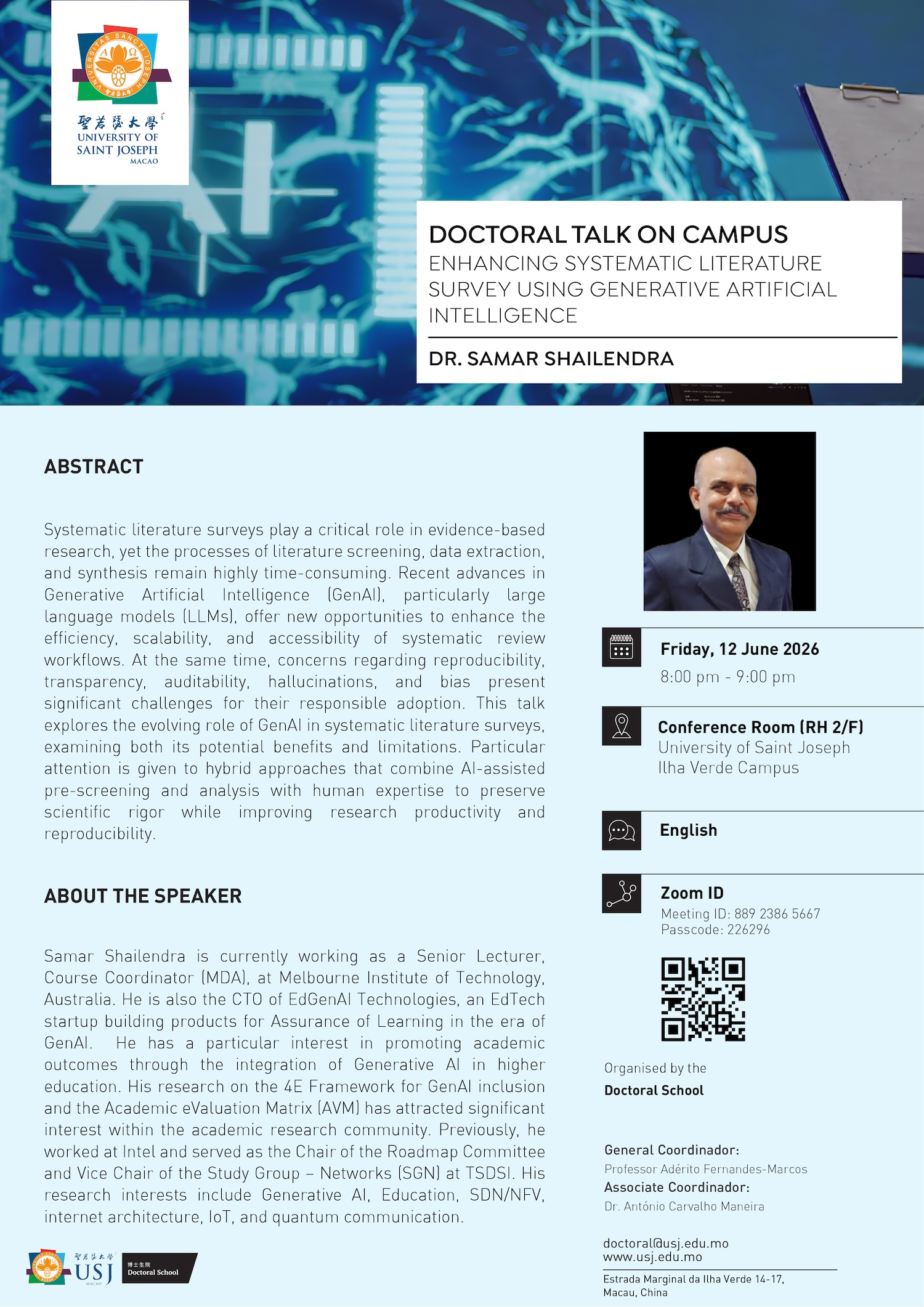
“Enhancing Systematic Literature Survey using Generative Artificial Intelligence”
Abstract: Systematic literature surveys play a critical role in evidence-based research, yet the processes of literature screening, data extraction, and synthesis remain highly time-consuming. Recent advances in Generative Artificial Intelligence (GenAI), particularly large language models (LLMs), offer new opportunities to enhance the efficiency, scalability, and accessibility of systematic review workflows. At the same time, concerns regarding reproducibility, transparency, auditability, hallucinations, and bias present significant challenges for their responsible adoption. This talk explores the evolving role of GenAI in systematic literature surveys, examining both its potential benefits and limitations. Particular attention is given to hybrid approaches that combine AI-assisted pre-screening and analysis with human expertise to preserve scientific rigor while improving research productivity and reproducibility.
Speaker: Dr. Samar Shailendra
Samar Shailendra is currently working as a Senior Lecturer, Course Coordinator (MDA), at Melbourne Institute of Technology, Australia. He is also the CTO of EdGenAI Technologies, an EdTech startup building products for Assurance of Learning in the era of GenAI. He has a particular interest in promoting academic outcomes through the integration of Generative AI in higher education. His research on the 4E Framework for GenAI inclusion and the Academic eValuation Matrix (AVM) has attracted significant interest within the academic research community. Previously, he worked at Intel and served as the Chair of the Roadmap Committee and Vice Chair of the Study Group – Networks (SGN) at TSDSI. His research interests include Generative AI, Education, SDN/NFV, internet architecture, IoT, and quantum communication.
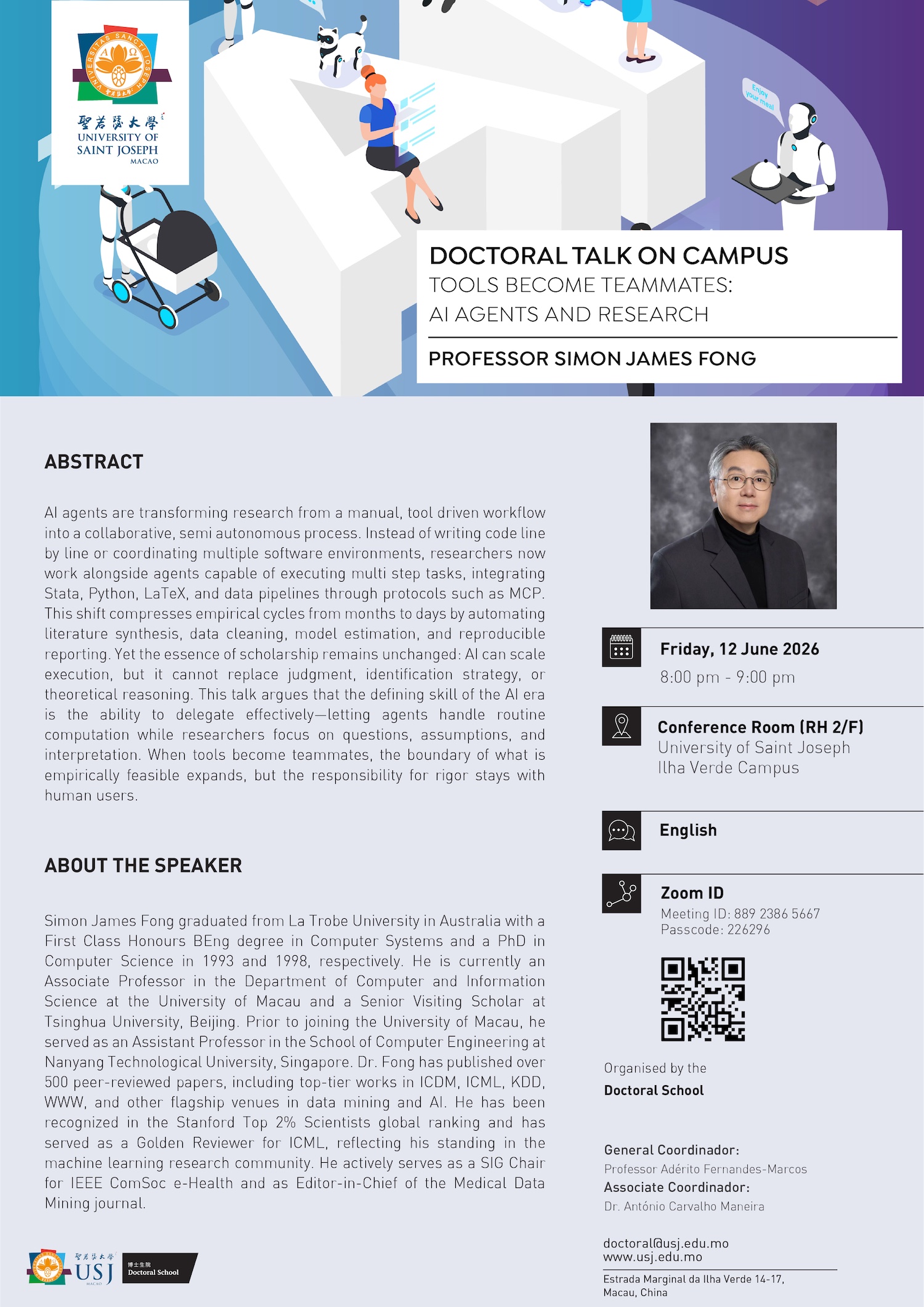
“Tools Become Teammates: AI Agents and Research”
Abstract: AI agents are transforming research from a manual, tool-driven workflow into a collaborative, semi-autonomous process. Instead of writing code line-by-line or coordinating multiple software environments, researchers now work alongside agents capable of executing multi-step tasks, integrating Stata, Python, LaTeX, and data pipelines through protocols such as MCP. This shift compresses empirical cycles from months to days by automating literature synthesis, data cleaning, model estimation, and reproducible reporting. Yet the essence of scholarship remains unchanged: AI can scale execution, but it cannot replace judgment, identification strategy, or theoretical reasoning. This talk argues that the defining skill of the AI era is the ability to delegate effectively—letting agents handle routine computation while researchers focus on questions, assumptions, and interpretation. When tools become teammates, the boundary of what is empirically feasible expands, but the responsibility for rigor stays with human users.
Speaker: Professor Simon James Fong
Simon James Fong graduated from La Trobe University in Australia with a First Class Honours BEng degree in Computer Systems and a PhD in Computer Science in 1993 and 1998, respectively. He is currently an Associate Professor in the Department of Computer and Information Science at the University of Macau and a Senior Visiting Scholar at Tsinghua University, Beijing. Prior to joining the University of Macau, he served as an Assistant Professor in the School of Computer Engineering at Nanyang Technological University, Singapore. Dr. Fong has published over 500 peer‑reviewed papers, including top‑tier works in ICDM, ICML, KDD, WWW, and other flagship venues in data mining and AI. He has been recognized in the Stanford Top 2% Scientists global ranking and has served as a Golden Reviewer for ICML, reflecting his standing in the machine learning research community. He actively serves as a SIG Chair for IEEE ComSoc e‑Health and as Editor‑in‑Chief of the Medical Data Mining journal.
PhD Presentations:
PhD Student: Shi Weixiong (Wyatt)
Title: From Infrastructure to Social Infrastructure: Integrating Public Space into Mono-Functional Urban Facilities in High-Density Macau
Abstract: This research examines how mono-functional urban infrastructure in high-density Macau—such as transport, waste, flood-defence, and parking facilities—can be reconceived as social infrastructure by integrating community-oriented public space within and around them. Using spatial mapping, comparative case studies, field observation, and stakeholder interviews, the study investigates design opportunities, constraints, and socio-spatial implications of such transformations. It aims to develop a transferable framework and conceptual design approach for converting infrastructural land into socially productive public space in compact urban contexts.
PhD Student: Lei Ka Ieng (Kit)
Title: Tianren Heyi in Spatial Computing. A generative and interactive design system for translating intangible cultural heritage into Azulejo patterns
Abstract: This practice-based research investigates how Macau’s dual heritage—Portuguese Azulejo aesthetics and Chinese herbal tea culture—can be translated into an interactive generative design system grounded in Tianren Heyi (unity of heaven and humanity). The project develops a scalable 9-grid Azulejo pattern system informed by Yin-Yang, the Five Elements, and medicinal plant knowledge, implemented through spatial computing and embodied interaction. Combining Design Science Research with artistic practice, the study examines how responsive projection and body-based interaction can deepen public understanding of intangible cultural heritage beyond surface-level visual representation.
PhD Student: Nguyen Trong Nghia (NT)
Title: Speculative visual scripts and the convergence of semiotic systems in Vietnam and Macau for a universal communication framework
Abstract: This project analyses the transformational potential of visual language by exploring the convergence of cultural legacy and future-oriented design systems to suggest a new form of communication that exists outside traditional linguistic limits. By drawing significant inspiration from the conceptual philosophy of Xu Bing and his ability to deconstruct how we perceive written symbols (Erickson 2001) the study identifies a unique synergy between the Latin based structural evolution of Vietnamese typography and the complex multilayered semiotic landscape of Macau. These two diverse cultural histories serve as the underlying palette for producing an evolutionary convergence where the strict norms of earlier scripts disintegrate into a more fluid and intuitive form of expression. Instead of relying on conventional graphic design methods the project adopts emergent systems to simulate how language might organically adapt and morph within a borderless futurity. This approach treats characters and symbols not as fixed icons but as living entities that react to one another and their environment to produce a dynamic visual experience that prioritizes human intuition over literal translation (Serafini and Clausen 2012).
The project aims to connect historical identity with the evolving digital landscape of the next fifty years by prioritising the creative core of the script over its technical or grammatical aspects. The resulting proposal manifests as a speculative visual script that remains deeply rooted in the historical traces of both Vietnam and Macau while offering a glimpse into a future where communication is liberated from the barriers of specific tongues. This artistic exploration finally examines the human yearning for connection and how our collective visual heritage might be integrated via contemporary creative frameworks to promote a more inclusive and expressive society. This journey into the evolution of the written word invites the viewer to reconsider the act of reading as a sensory experience that honors where we have been while embracing the boundless possibilities of where we are going (Xu Bing 2006).