Lifelong Learning


Lifelong Learning Office (LLO) is offering a course to students who are interested in studying Latin and have completed the Latin basic I course or 30 hours of Latin Language Learning.
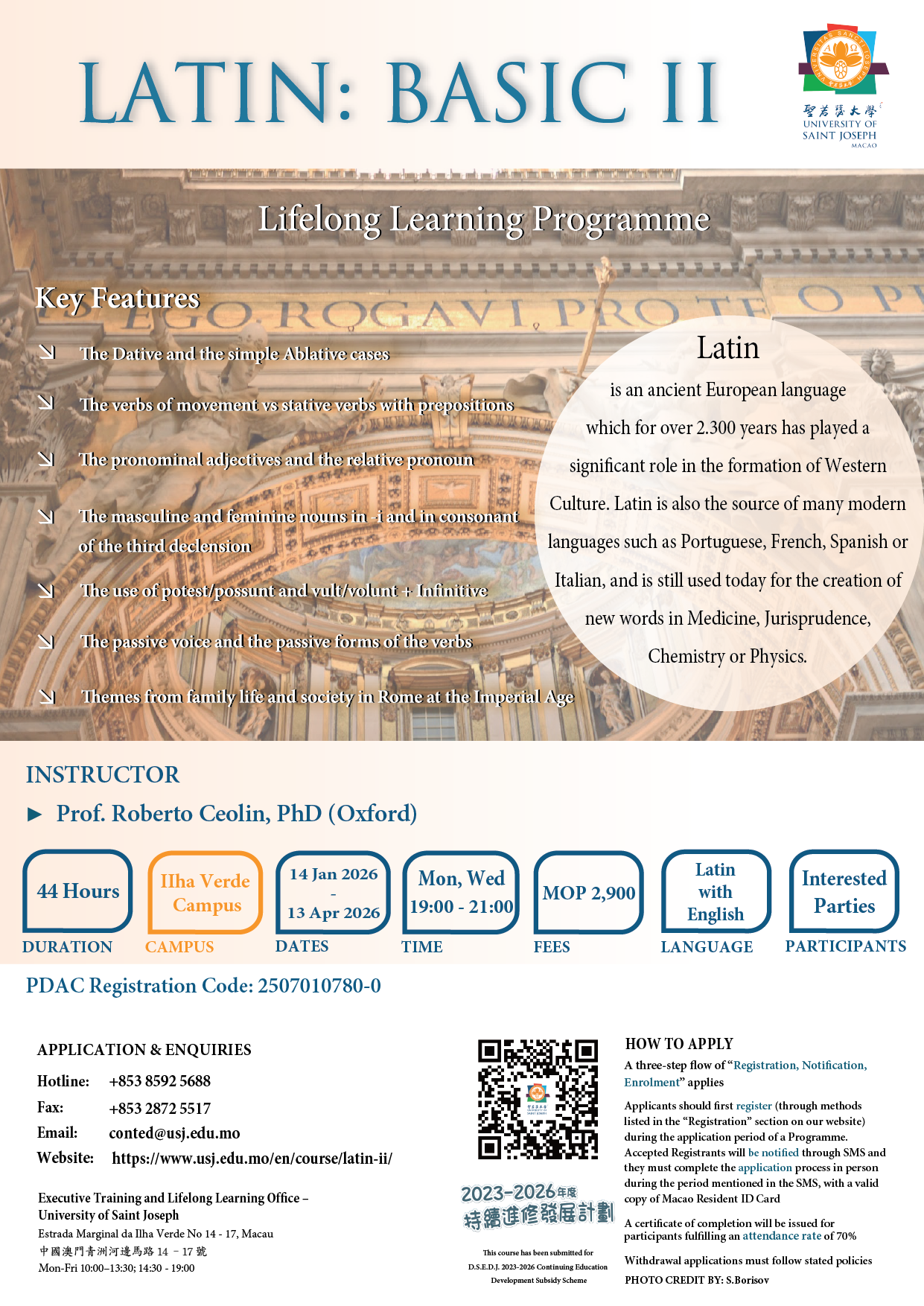

Download poster (English version / Chinese version)

Course Content:

Theme 9 – Pastor et Oves

  • Introduction to the 3rd declension nouns in -i and also some nouns in consonant
  • The combination of 3rd declension nouns with 1st and second declension adjectives
  • The forms est ‘he is’ vs est ‘he eats’
Theme 10 – Bestiae et Homines

  • Continuation of the 3rd declension – other nouns in consonant with inparisyllabic nominative-genitive.
  • The infinitive and verbal phrases with the infinitive.
  • The forms of the verb velle.
Theme 11 – Corpus Humanum

  • The parts of the human body; the language of health and disease; Conversation about someone else’s health.
  • Grammar: Reported speech and the infinitive clause;
  • The neuter of 3rd declension nouns in consonant
Theme 12 – Miles Romanus

  • Roman military language; Roman measurements.
  • Grammar: The false imparisyllabic of the 3rd declension; the nouns of the 4th declension. The biform adjectives of the 3rd declension and the comparative of superiority
Theme 13 – Annus et Menses

  • The Roman calendar: the name of the months, the phases of the moon and the signs of the Zodiac. The weather and the division of the day and the night.
  • Grammar: The Fifth Declension; the superlative of the adjective.
Theme 14 – Novus Dies

  • Themes and vocabulary for the morning of a new day. Description of activities in the house in the morning period.
  • Grammar: The present Participle
Theme 15 – Magister et Discipuli

  • Themes and vocabulary of life in the school and classroom; conversation including the subject and the interlocutor.
  • Grammar: the 1st and 2nd persons Singular/Plural persons of the verb for all for conjugation + the verb sum ‘to be’ and possum ‘to be able’

Learning Outcomes:

  • Use all the cases of the Latin nominal system in their primary functions
  • Agree adjectives and nouns of different declensions
  • Construct semi-complex sentences, such as relative clauses
  • To be able to use the correct form of the relative pronouns when composing a relative clause
  • Use the active and the passive voices with the agent
  • Understand the roles of the simple ablative for expressing means/agent
  • Use the infinitive as the complement of verbs meaning ‘being able’ and ‘wanting’ to do something,
  • Have acquired basic vocabulary (ca.250-300 words)

Details:

Instructor: Roberto Ceolin PhD
Date: 14 January to 13 April 2026
(16, 18, 23 February and 06 April 2026 excluded)
Time: Mon, Wed 19:00 – 21:00
Duration: 44 Hours (22 Sessions)
Location: University of Saint Joseph – IIha Verde Campus
Language: Latin supplemented with English
Delivery of Mode: Face-to-face Lecture
Tuition Fee: MOP2,900
Targeted Participants: Interested parties


Biography of Speaker:

Roberto Ceolin, MA (Conim.), MPhil, DPhil (Oxon.) was educated in Coimbra, Salamanca, Salzburg and Oxford. He wrote his doctoral thesis on the Greek verb. He has taught Latin and Greek, as well as courses on historical and synchronic linguistics, in Salamanca, Salzburg and Oxford. At present he teaches ancient languages at the Faculty of Theology-USJ, Macau.


Note: This course has been submitted for D.S.E.D.J. 2023-2026 Continuing Education Development Subsidy Scheme; the Lifelong Learning Public Programmes Tuition Fee Discount Policy (LLO-529) is NOT available for applying for this course.


HOW TO APPLY

A three-step flow of “Registration, Notification, Enrolment” applies.

Applicants should first register (through methods listed in the “Registration” section on our website) during the application period of a Programme. Accepted Registrants will be notified through SMS and they must complete the application process in person during the period mentioned in the SMS, with a valid copy of Macao Resident ID Card.

A certificate of completion will be issued for participants fulfilling an attendance rate of 70%.

Withdrawal applications must follow stated policies.

Remark: Programmes may be cancelled due to insufficient registration.