
Alumni Stories | Paulo Cheong: A Boundless Mindset Brings Infinite Possibilities
Alumni Stories | Paulo Cheong: A Boundless Mindset Brings Infinite Possibilities
02
Sep
02/09/2025
Learning is shaped by varied tasks and challenges. The idea that it never truly ends captures the heart of education—not a sprint, but a lifelong marathon of growth. Along the way, should one follow a well-worn path or dare to forge their own? And for our interviewee, what does it take to break boundaries, bridge study and practice, and gain a lasting edge in professional life?
Learning is shaped by varied tasks and challenges. The idea that it never truly ends captures the heart of education—not a sprint, but a lifelong marathon of growth. Along the way, should one follow a well-worn path or dare to forge their own? And for our interviewee, what does it take to break boundaries, bridge study and practice, and gain a lasting edge in professional life?
Equipping Himself: USJ’s Global Vision Fuels Professional Growth
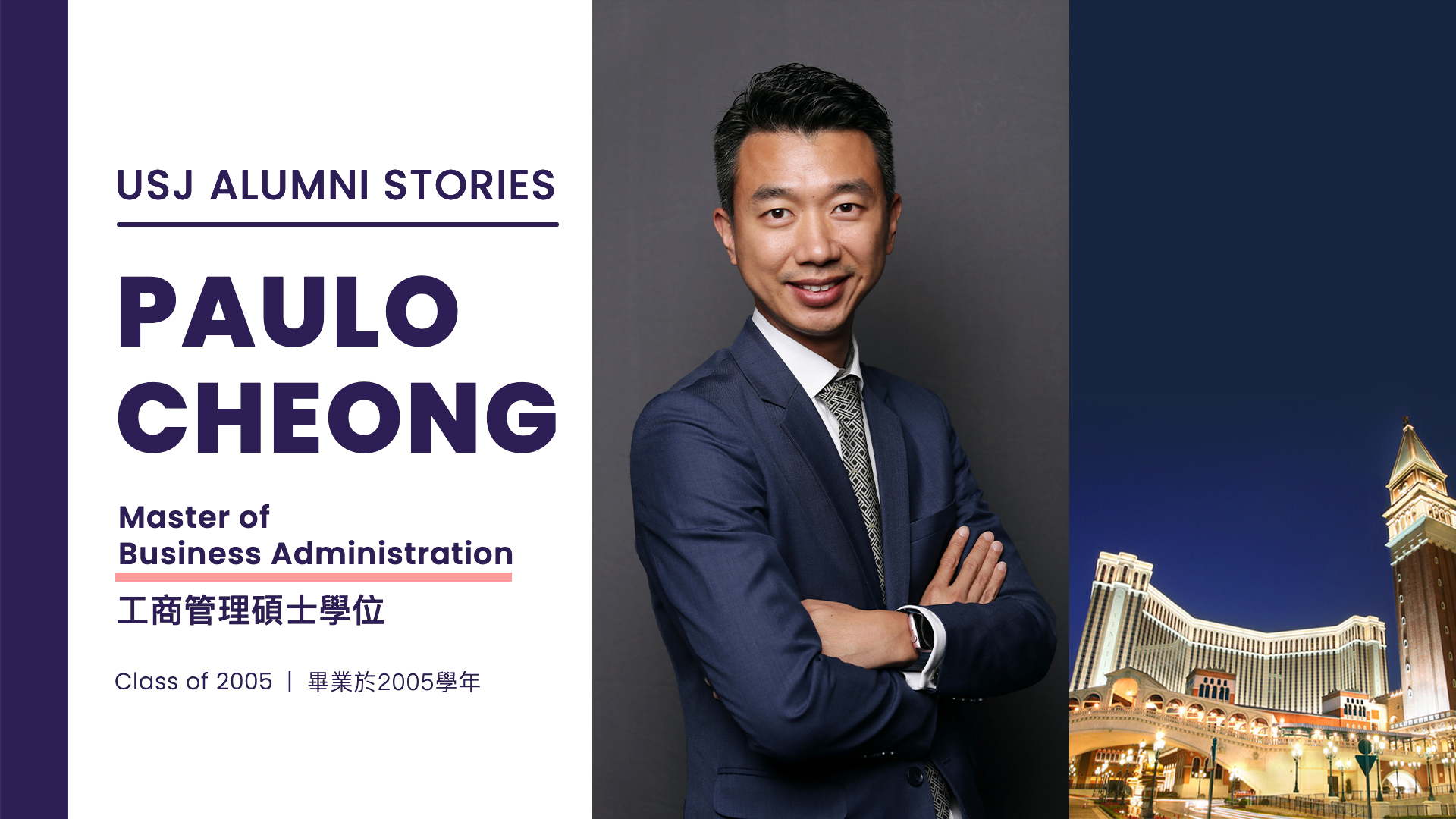
Mr. Paulo Cheong, currently the Senior Vice President of Human Resources at Sands China Ltd. and head of its HR department, graduated in 2005 with an MBA from USJ’s Faculty of Business and Law (FBL). Reflecting on his decision to enroll, he shared: “I joined the MBA program in 2003 at USJ, then known as the Macau Inter-University Institute. It was the early days of Macao’s gaming liberalization, with international firms flooding in. The city’s industries, talent demands, and management culture were transforming rapidly. I realized that to advance professionally, I needed structured management training to thrive in a globalized and structured workplace.”
His first impression of USJ centered on its flexible scheduling, which allowed for a healthy balance between work and study, and its international faculty from Europe, Portuguese-speaking countries, and beyond—many of them affiliated with the Catholic University of Portugal. “Their cross-cultural perspectives reshaped the wat I approached organizational management and HR planning in multicultural settings.”
During his MBA studies, he engaged with pragmatic theories in strategic management, leadership, and HR systems. “This foundation later guided my work in crafting corporate HR policies and leading teams. My thesis—on how service quality affected customer satisfaction among Macao’s mobile users—honed my research and data analysis skills, which I still draw on today when developing employer branding strategies.”
Mentorship That Shapes: Theory Meets Real-World Wisdom
When it comes to applying USJ’s academic frameworks and guidance to professional practice, Paulo credits his thesis advisor, Professor Richard Whitfield, as a transformative influence. “As an Australian PHD graduate from the University of Melbourne, he served as USJ’s Pro-Rector for Organizational Development from 2003 to 2012. Professor Whitfield combined a solid academic foundation with hands-on expertise in manufacturing, operational, and management and tourism . He instilled in us the importance of designing organizational strategies with long-term sustainability in mind, rather short-term gains. To this day, his lessons still resonate in my work.”
USJ’s emphasis on open dialogue and cross-cultural collaboration is widely recognized. Reflecting on how this environment amplifies learning outcomes, Paulo shared: “Global enterprises thrive on international synergy. Beyond technical skills, young professionals must cultivate cultural agility to build trust across borders—whether with clients, colleagues, or partners. USJ’s commitment to an open, diverse, and collaborative ecosystem gives students immersive exposure to multicultural exchanges, both in and beyond classrooms. Graduates emerge ready to navigate complex workplace dynamics with resilience.”
He emphasized the urgency of this approach: “As our city diversifies its economy and deepens ties with the Greater Bay Area, Lusophone and Spanish-speaking countries, and ASEAN markets, cultivating talents with global acumen is crucial.” USJ’s two-year MBA programme is designed to forge visionary leaders, blending global business mastery, ethical leadership, and practical application to hone strategic decision-making and innovation.
Language Skills and Cultural Agility: Keys to Career Edge
To bridge the gap between academic learning and the professional world, Paulo has frequently returned to USJ as a guest speaker for career seminars. Speaking to undergraduates, he positions language proficiency as a vital professional asset: “Recruiters today assess candidates through a dual lens – academic credentials must be matched by workplace adaptability. That’s why I urge students to seize every hands-on opportunity, from internships to corporate visits. USJ has been remarkably proactive in arranging these experiences across Macao, Hengqin, Hong Kong, mainland China, and beyond. For example, recently,a delegation from the Institute of Science and Environment (ISE) visited Sands China to explore our sustainability initiatives. These immersive encounters allow students to grasp corporate culture and workplace dynamics first-hand. At our organization, we actively recruit interns from diverse academic fields and immerse them in the workings of large-scale business operations.”
“Beyond Cantonese, Mandarin and English – our regional lingua francas – I recommend learning languages such as Portuguese, Spanish or Korean, particularly for those looking to tap into Macao’s growing links with international markets. Each new language unlocks cultural perspectives that often translate into professional advantages.”
Paulo also emphasizes the importance of technological fluency: “AI and big data analytics have moved beyond their STEM roots to revolutionize every sector – from marketing to HR, finance to operations. In integrated resorts like Sands China, intelligent transformation is accelerating across all business verticals. Regardless of your major, I strongly encourage early exposure to these disruptive technologies through workshops and specialized courses as they’re fact becoming the new professional literacy.”
Giving Back: Alumni Dialogues Spark Innovation
Since graduating from USJ, Paulo has remained actively engaged with his alma mater, including returning to campus to introduce corporate talent initiatives to graduating students. He finds these interactions remarkably reciprocal—the incisive questions and fresh perspectives from younger generations often spark new inspirations, motivating him to develop more structured youth development programmes.
“Participating in university events not only reconnects me with professors and classmates, but also allows me to interact with a new generation of students from diverse backgrounds,” he reflects. “When presenting Sands China’s career opportunities and youth development initiatives—like our Integrated Resort Business Analyst Development Programme—to soon-to-graduate students, I’m consistently impressed by their perceptive observations on emerging social trends and current affairs. Their questions frequently offer novel angles that prompt me to reevaluate how we attract and nurture young talent.”
These exchanges have reinforced his commitment to working with government and industry partners to implement more systematic and targeted local youth development initiatives within Sands China. Paulo also values attending alumni gatherings organized by the Office for Student and Alumni Affairs (OSAA) and Alumni Association of USJ (AAUSJ), where meaningful dialogues with faculty members, current students, and graduates keep him updated on the university’s latest educational priorities. “These cross-generational conversations reveal how USJ’s community continues to foster professional discourse and collaboration in ever-evolving ways,” he notes.
To the Next Generation: Cultivate a Boundless Mindset
In an era of unprecedented change and rapid societal evolution, Paulo often sees one common misconception—that choosing a career path guarantees smooth, step-by-step progress. Drawing on his experience in Macao’s integrated resort industry, where innovative cross-sector models like “tourism + sports,” “tourism + MICE,” and “tourism + wellness” are gaining momentum, he highlighted : “These days, every industry is looking for people who can cut across traditional boundaries.”
His advice to students is straight to the point: “Whatever direction you take, those who build a wide skill, open their minds, and push beyond their comfort zones will always have the edge. To USJ students, I’d say: keep your curiosity alive—wisdom begins with wonder. Look beyond lecture halls; stay tuned to the world around you. Don’t be in a rush to label yourself or assume your path is fixed. The ones who get ahead are those willing to push past their own limits.