USJ Macau Observatory for Social Development Jointly Released the Results of Survey on Macao’s Management Personnel
USJ Macau Observatory for Social Development Jointly Released the Results of Survey on Macao's Management Personnel
18
Dec
18/12/2025
The Social and Behavioral Sciences Research of Macao and the Macao Observatory for Social Development at the University of Saint Joseph (USJ) released findings on a survey titled “Continuing Education Intentions and Social Mobility Among Macao Enterprise Personnel in the Context of the Greater Bay Area Initiative”.
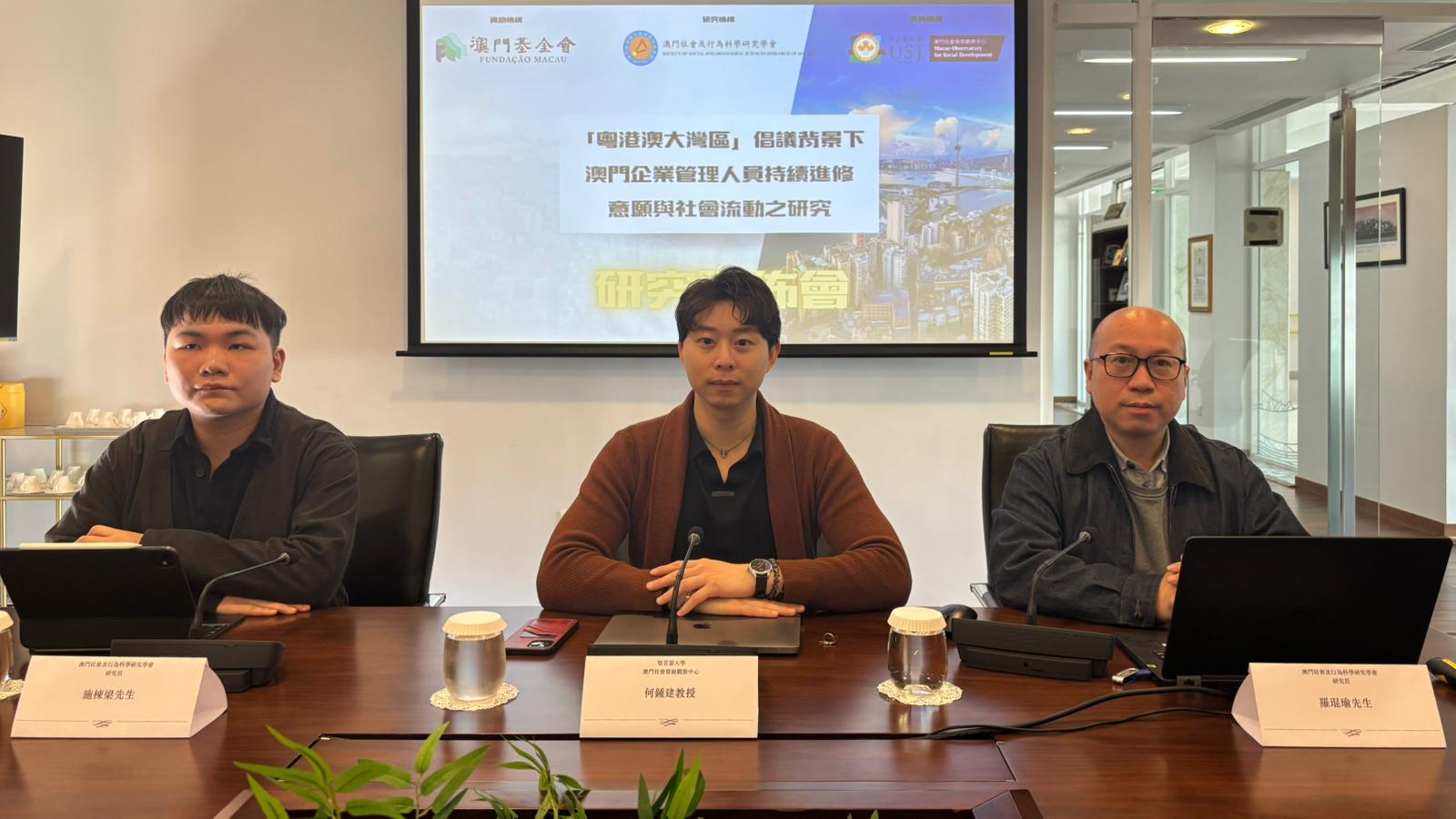
The Social and Behavioral Sciences Research of Macao and the Macao Observatory for Social Development at the University of Saint Joseph (USJ) released findings on December 16 regarding a survey titled “Continuing Education Intentions and Social Mobility Among Macao Enterprise Personnel in the Context of the Greater Bay Area Initiative”. This study, funded by the Macao Foundation, was conducted between March and December, 2025. At the press conference, the findings were presented by Dr. Jacky Ho, Mr. Victor Lo, and Mr. Si Tong Leong.
The survey revealed that most respondents perceive insufficient opportunities for upward social mobility, making continuing education a critical pathway. Significant behavioral and motivational differences emerged across groups: female is more inclined to pursue further education for knowledge enhancement, while male focus on networking. Individuals with higher education levels demonstrate significantly greater participation in continuing education than those with lower qualifications. Additionally, job position and income profoundly influence motivation for continuing education and career stability. Senior and high-income personnel exhibit stronger career stability and pursue continuing education primarily for self-actualization. Those who recognize the need for enhanced educational knowledge to achieve social mobility and actively participate in external continuing education programs demonstrate higher willingness and intrinsic motivation for such pursuits.
Dr. Jacky Ho, Director of the USJ Macao Observatory for Social Development, highlighted that this survey aligns with the Greater Bay Area development strategy, revealing key bottlenecks and motivational mechanisms for Macao’s management talent during regional integration. Data clearly indicates that over half of managers perceive insufficient upward mobility opportunities. This reflects not only individual career anxieties but also systemic challenges Macao’s industrial structure must address during its transformation. While the overall desire for continuous learning remains strong, its translation into action is significantly influenced by educational background, workplace hierarchy, and gender strategies. He emphasized that “especially within the context of Greater Bay Area integration, effectively aligning individual professional development with cross-regional career pathways is key to overcoming mobility challenges.”
Based on these findings, the research team proposes a series of policy and practical recommendations to encourage the continuous development and social mobility of Macao’s management talent within the Greater Bay Area context, thereby facilitating the integration of Macao’s professionals into the region’s broader development.