
Doctoral Forum in Education 2026
Doctoral Forum in Education 2026
08
May
The USJ Doctoral School and the School of Education are organising a Doctoral Forum in the study/research area of Education on Friday 8 May, from 7PM, in the USJ Conference Room.
Programme Details:
Date: Friday, 8 May 2026
Time: 7 PM – 10:00 PM
Location: Conference Room, 2/F, Residential Hall Building, USJ Ilha Verde Campus
Language: English
Organised by: Doctoral School and School of Education
Contact: doctoral@usj.edu.mo
*Free event, open to the general public
Meeting ID: 889 2386 5667
Passcode: 226296
Schedule:
- 19:00 – Welcoming address
- 19:10 – Dr António Maneira: The Digital Storyteller: Fostering Resilience and Cultural Sustainability in Online Education
- 19:40 – Dr Sayma Arju: Beyond Writer’s Block: Navigating Conceptual, Methodological, and Collaborative Challenges in Doctoral Research (online)
- 20:10 – Refreshments Break
- 20:40 – Dr Yong Liu: Strategies for International Journal Publication and Peer Review
- 21:10 – Phd Candidate: Renata de Sousa
- 21:40 – Closing remarks
DOCTORAL TALKS ON CAMPUS:
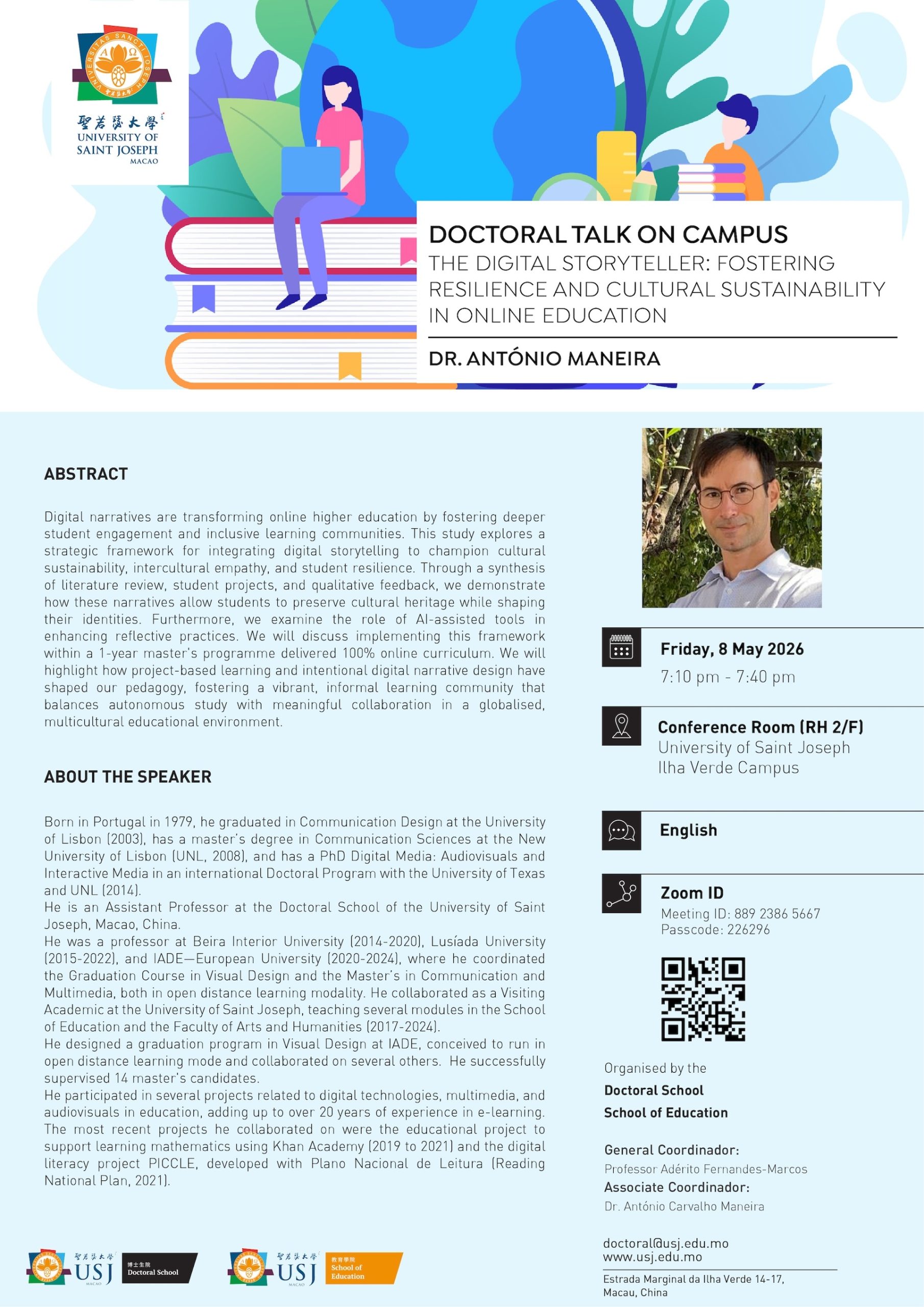
The Digital Storyteller: Fostering Resilience and Cultural Sustainability in Online Education
Abstract:
Digital narratives are transforming online higher education by fostering deeper student engagement and inclusive learning communities. This study explores a strategic framework for integrating digital storytelling to champion cultural sustainability, intercultural empathy, and student resilience. Through a synthesis of literature review, student projects, and qualitative feedback, we demonstrate how these narratives allow students to preserve cultural heritage while shaping their identities. Furthermore, we examine the role of AI-assisted tools in enhancing reflective practices. We will discuss implementing this framework within a 1-year master’s programme delivered 100% online curriculum. We will highlight how project-based learning and intentional digital narrative design have shaped our pedagogy, fostering a vibrant, informal learning community that balances autonomous study with meaningful collaboration in a globalised, multicultural educational environment.
About the Speaker:
Dr António Maneira
Born in Portugal in 1979, he graduated in Communication Design at the University of Lisbon (2003), has a master’s degree in Communication Sciences at the New University of Lisbon (UNL, 2008), and has a PhD Digital Media: Audiovisuals and Interactive Media in an international Doctoral Program with the University of Texas and UNL (2014).
He is an Assistant Professor at the Doctoral School of the University of Saint Joseph, Macao, China.
He was a professor at Beira Interior University (2014-2020), Lusíada University (2015-2022), and IADE—European University (2020-2024), where he coordinated the Graduation Course in Visual Design and the Master’s in Communication and Multimedia, both in open distance learning modality. He collaborated as a Visiting Academic at the University of Saint Joseph, teaching several modules in the School of Education and the Faculty of Arts and Humanities (2017-2024).
He designed a graduation program in Visual Design at IADE, conceived to run in open distance learning mode and collaborated on several others. He successfully supervised 14 master’s candidates.
He participated in several projects related to digital technologies, multimedia, and audiovisuals in education, adding up to over 20 years of experience in e-learning. The most recent projects he collaborated on were the educational project to support learning mathematics using Khan Academy (2019 to 2021) and the digital literacy project PICCLE, developed with Plano Nacional de Leitura (Reading National Plan, 2021).
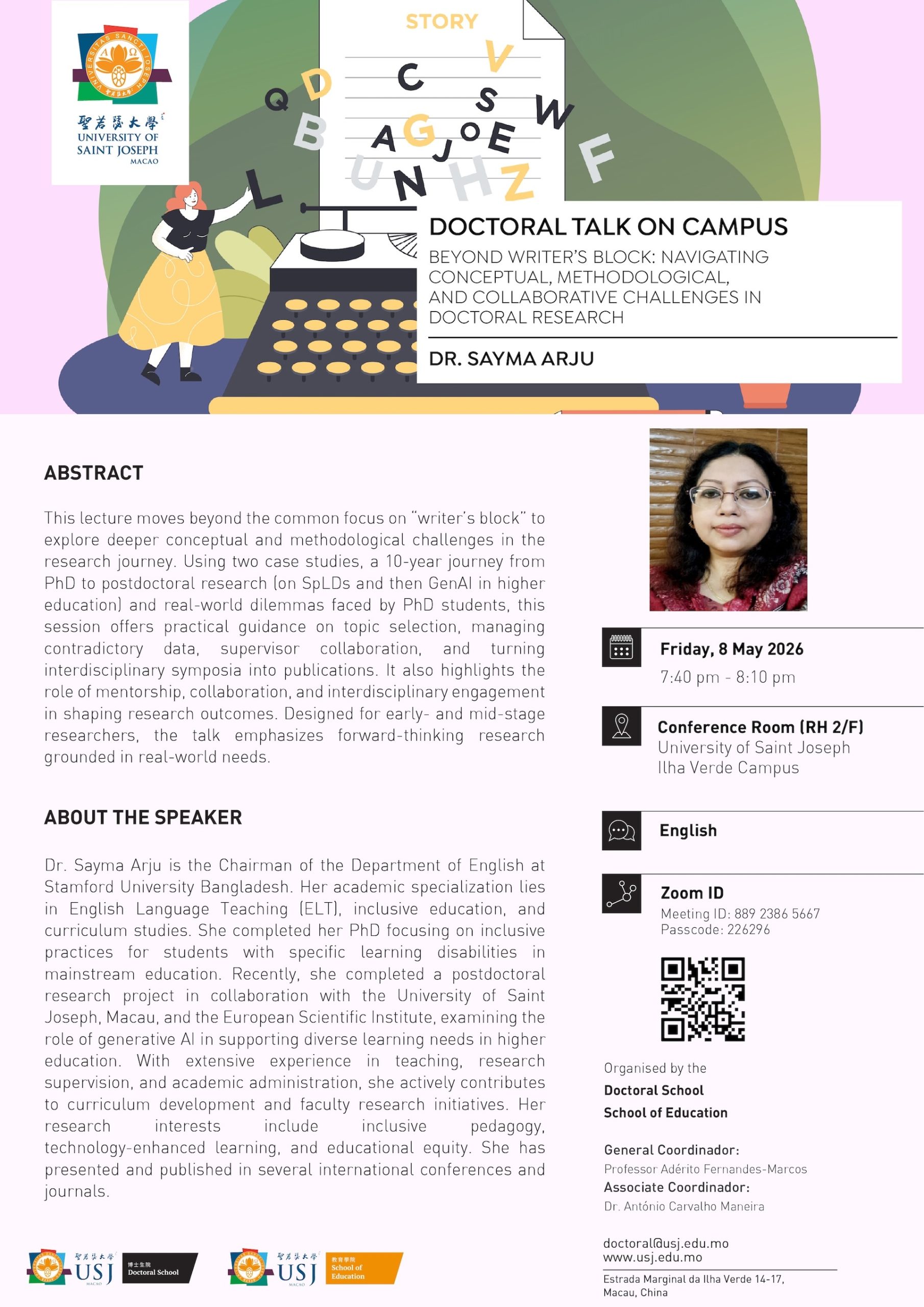
Beyond Writer’s Block: Navigating Conceptual, Methodological, and Collaborative Challenges in Doctoral Research
Abstract:
This lecture moves beyond the common focus on “writer’s block” to explore deeper conceptual and methodological challenges in the research journey. Using two case studies, a 10-year journey from PhD to postdoctoral research (on SpLDs and then GenAI in higher education) and real-world dilemmas faced by PhD students, this session offers practical guidance on topic selection, managing contradictory data, supervisor collaboration, and turning interdisciplinary symposia into publications. It also highlights the role of mentorship, collaboration, and interdisciplinary engagement in shaping research outcomes. Designed for early- and mid-stage researchers, the talk emphasizes forward-thinking research grounded in real-world needs.
About the Speaker:
Dr Sayma Arju
Dr. Sayma Arju is the Chairman of the Department of English at Stamford University Bangladesh. Her academic specialization lies in English Language Teaching (ELT), inclusive education, and curriculum studies. She completed her PhD focusing on inclusive practices for students with specific learning disabilities in mainstream education. Recently, she completed a postdoctoral research project in collaboration with the University of Saint Joseph, Macau, and the European Scientific Institute, examining the role of generative AI in supporting diverse learning needs in higher education. With extensive experience in teaching, research supervision, and academic administration, she actively contributes to curriculum development and faculty research initiatives. Her research interests include inclusive pedagogy, technology-enhanced learning, and educational equity. She has presented and published in several international conferences and journals.
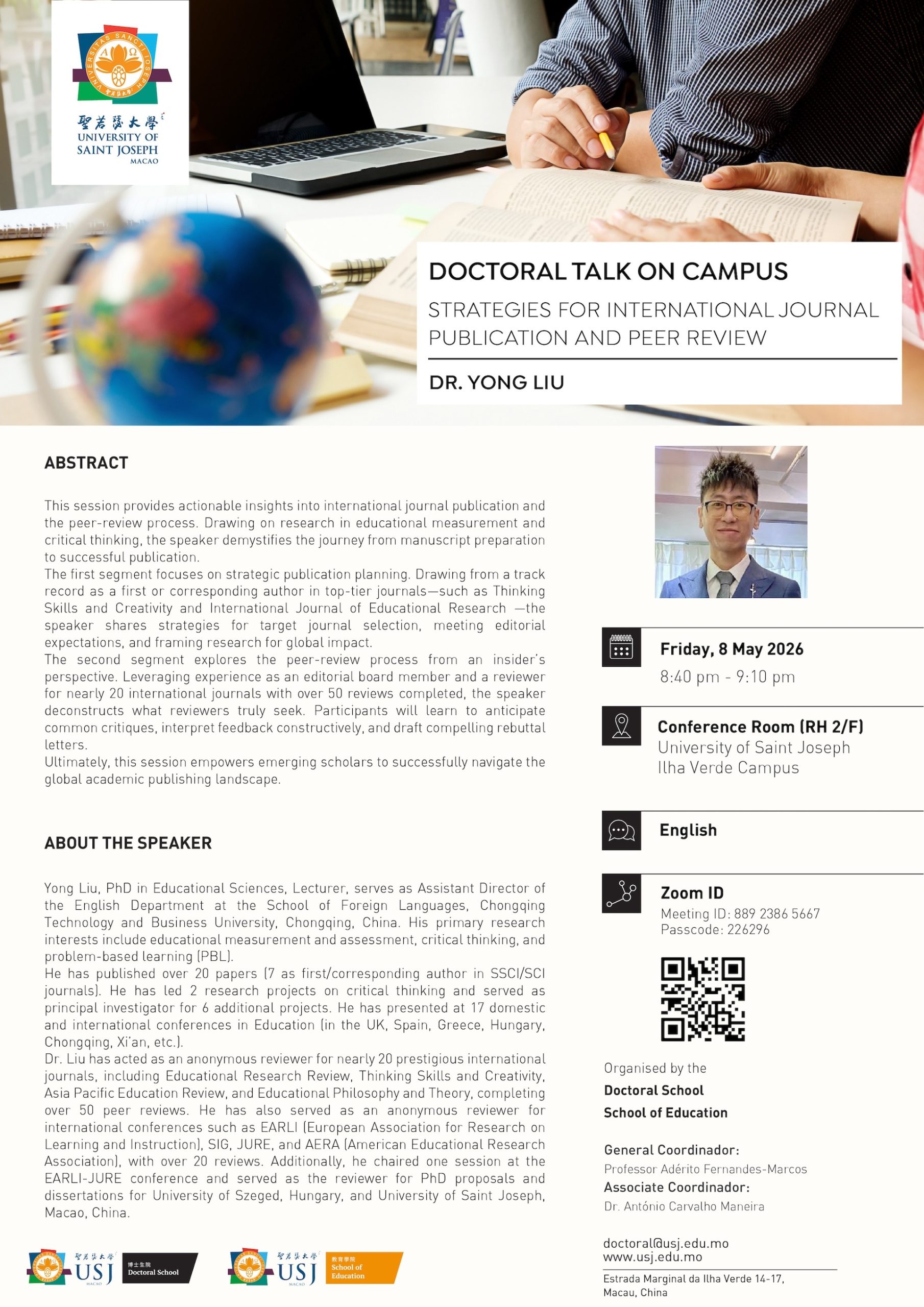
Strategies for International Journal Publication and Peer Review
Abstract:
This session provides actionable insights into international journal publication and the peer-review process. Drawing on research in educational measurement and critical thinking, the speaker demystifies the journey from manuscript preparation to successful publication.
The first segment focuses on strategic publication planning. Drawing from a track record as a first or corresponding author in top-tier journals—such as Thinking Skills and Creativity and International Journal of Educational Research —the speaker shares strategies for target journal selection, meeting editorial expectations, and framing research for global impact.
The second segment explores the peer-review process from an insider’s perspective. Leveraging experience as an editorial board member and a reviewer for nearly 20 international journals with over 50 reviews completed, the speaker deconstructs what reviewers truly seek. Participants will learn to anticipate common critiques, interpret feedback constructively, and draft compelling rebuttal letters.
Ultimately, this session empowers emerging scholars to successfully navigate the global academic publishing landscape.
About the Speaker:
Dr. Yong Liu
Yong Liu, PhD in Educational Sciences, Lecturer, serves as Assistant Director of the English Department at the School of Foreign Languages, Chongqing Technology and Business University, Chongqing, China. His primary research interests include educational measurement and assessment, critical thinking, and problem-based learning (PBL).
He has published over 20 papers (7 as first/corresponding author in SSCI/SCI journals). He has led 2 research projects on critical thinking and served as principal investigator for 6 additional projects. He has presented at 17 domestic and international conferences in Education (in the UK, Spain, Greece, Hungary, Chongqing, Xi’an, etc.).
Dr. Liu has acted as an anonymous reviewer for nearly 20 prestigious international journals, including Educational Research Review, Thinking Skills and Creativity, Asia Pacific Education Review, and Educational Philosophy and Theory, completing over 50 peer reviews. He has also served as an anonymous reviewer for international conferences such as EARLI (European Association for Research on Learning and Instruction), SIG, JURE, and AERA (American Educational Research Association), with over 20 reviews. Additionally, he chaired one session at the EARLI-JURE conference and served as the reviewer for PhD proposals and dissertations for University of Szeged, Hungary, and University of Saint Joseph, Macao, China.
(PhD Candidates Presentation)
MODELIN: An Integrated Methodological Model for Teacher Education and STEM Teaching through Phenomenon-Based Modeling
Abstract:
The fragmentation of Natural Sciences and Mathematics in Brazilian secondary education reflects a structural problem rooted in rigid curricular models that reduce Mathematics to a calculation tool. This research proposes Integrated Scientific Modeling (ISM) as the theoretical-methodological construct that underpins MODELIN – a methodological model structured in seven recursive phases and built on three pillars: curricular interdisciplinarity, Mathematics as the language of science (via ISM), and technological mediation (TPACK). Rather than an additional STEM framework, MODELIN offers a structured operational path that positions Mathematics as the syntax of scientific inquiry. Using Design-Based Research, the study combines a teacher co-design cycle with a classroom implementation cycle. International theoretical validation is currently underway at the University of Saint Joseph, Macau, under the PDSE/CAPES Sandwich Doctorate Programme.
Phd Candidate: Renata de Sousa