
Doctoral Forum in Global Studies 2026
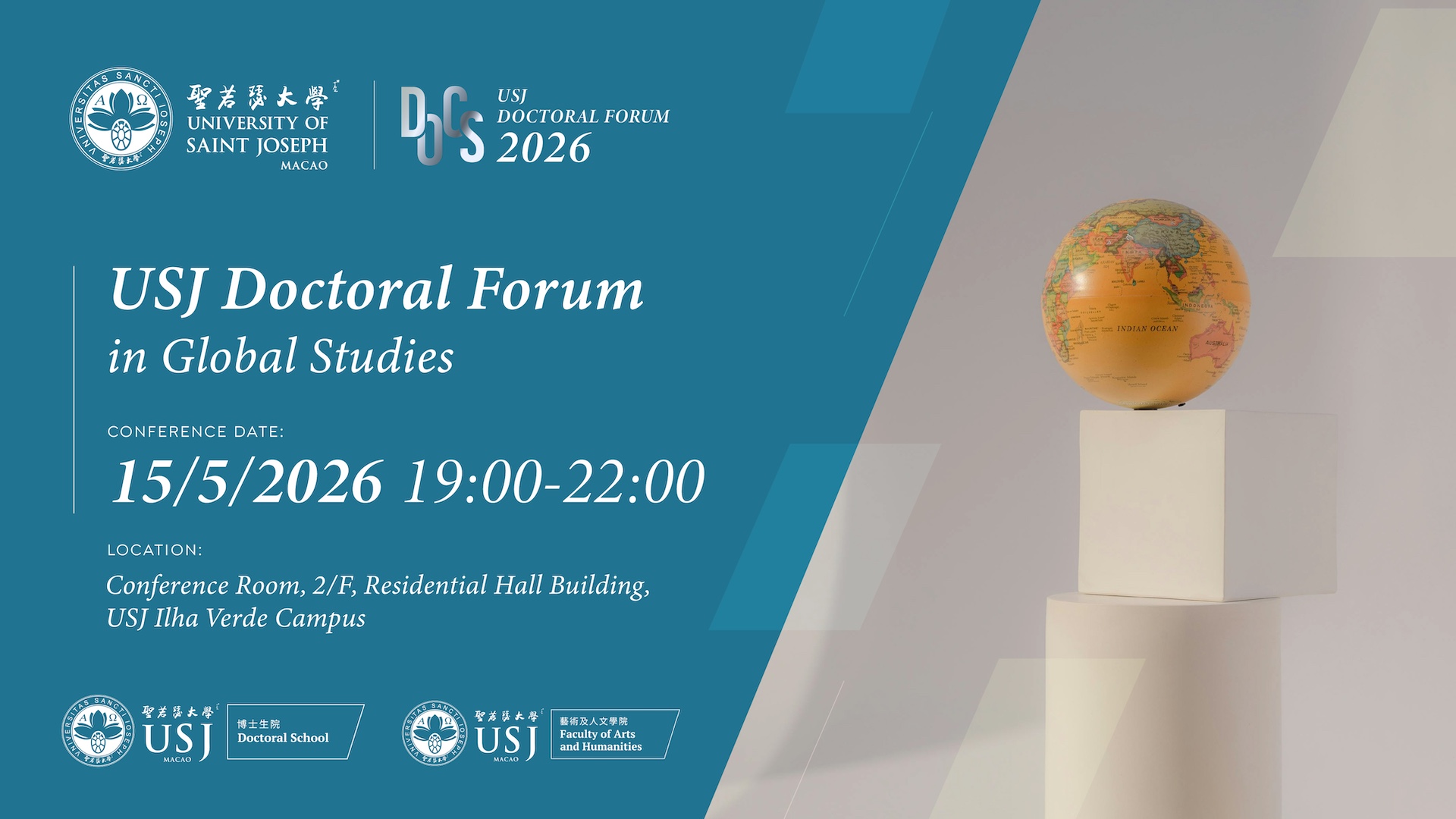
Doctoral Forum in Global Studies 2026
15
May
The USJ Doctoral School and the Faculty of Arts and Humanities are organising a Doctoral Forum in the study/research area of Global Studies on Friday 15 May, from 7PM, in the USJ Conference Room.
Programme Details:
Date: Friday, 15 May 2026
Time: 7 PM – 10:00 PM
Location: Conference Room, 2/F, Residential Hall Building, USJ Ilha Verde Campus
Language: English
Organised by: Doctoral School and Faculty of Art and Humanities
Contact: doctoral@usj.edu.mo
*Free event, open to the general public
Meeting ID: 889 2386 5667
Passcode: 226296
Schedule:
- 19:00 – Welcoming address (Professor Adérito Fernandes-Marcos, Dean of the Doctoral School)
- 19:10 – Presentation of research lines in the Faculty of Arts and Humanities (Dr Carlos Sena Caires, Dean of the Faculty of Arts and Humanities)
- 19:20 – Doctoral Talk: Dr PerMagnus Lindborg
- 20:00 – Doctoral Talk: Dr Marina Peres, Visiting Academic
- 20:30 – Alice Kok, PhD Candidate
- 20:50 – Coffee break
- 21:10 – Guided tour of the laboratories
DOCTORAL TALKS ON CAMPUS:
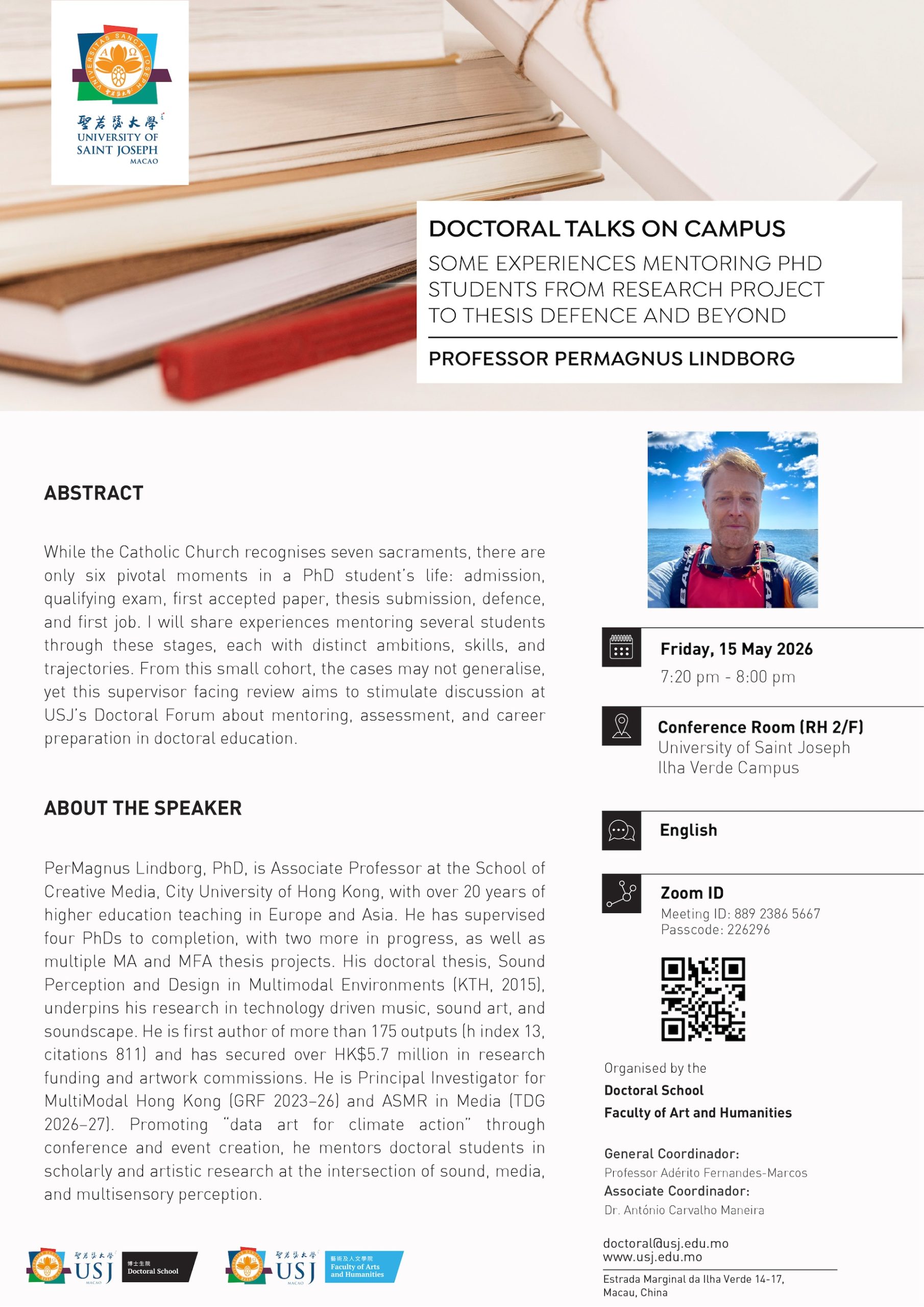
Some Experiences Mentoring PhD Students from Research Project to Thesis Defence and Beyond
Abstract:
While the Catholic Church recognises seven sacraments, there are only six pivotal moments in a PhD student’s life: admission, qualifying exam, first accepted paper, thesis submission, defence, and first job. I will share experiences mentoring several students through these stages, each with distinct ambitions, skills, and trajectories. From this small cohort, the cases may not generalise, yet this supervisor-facing review aims to stimulate discussion at USJ’s Doctoral Forum about mentoring, assessment, and career preparation in doctoral education.
About the Speaker:
Professor PerMagnus Lindborg
PerMagnus Lindborg, PhD, is Associate Professor at the School of Creative Media, City University of Hong Kong, with over 20 years of higher-education teaching in Europe and Asia. He has supervised four PhDs to completion, with two more in progress, as well as multiple MA and MFA thesis projects. His doctoral thesis, Sound Perception and Design in Multimodal Environments (KTH, 2015), underpins his research in technology-driven music, sound art, and soundscape. He is first author of more than 175 outputs (h-index 13, citations 811) and has secured over HK$5.7 million in research funding and artwork commissions. He is Principal Investigator for MultiModal Hong Kong (GRF 2023–26) and ASMR in Media (TDG 2026–27). Promoting “data art for climate action” through conference and event creation, he mentors doctoral students in scholarly and artistic research at the intersection of sound, media, and multisensory perception. (https://permagnus.org/new).
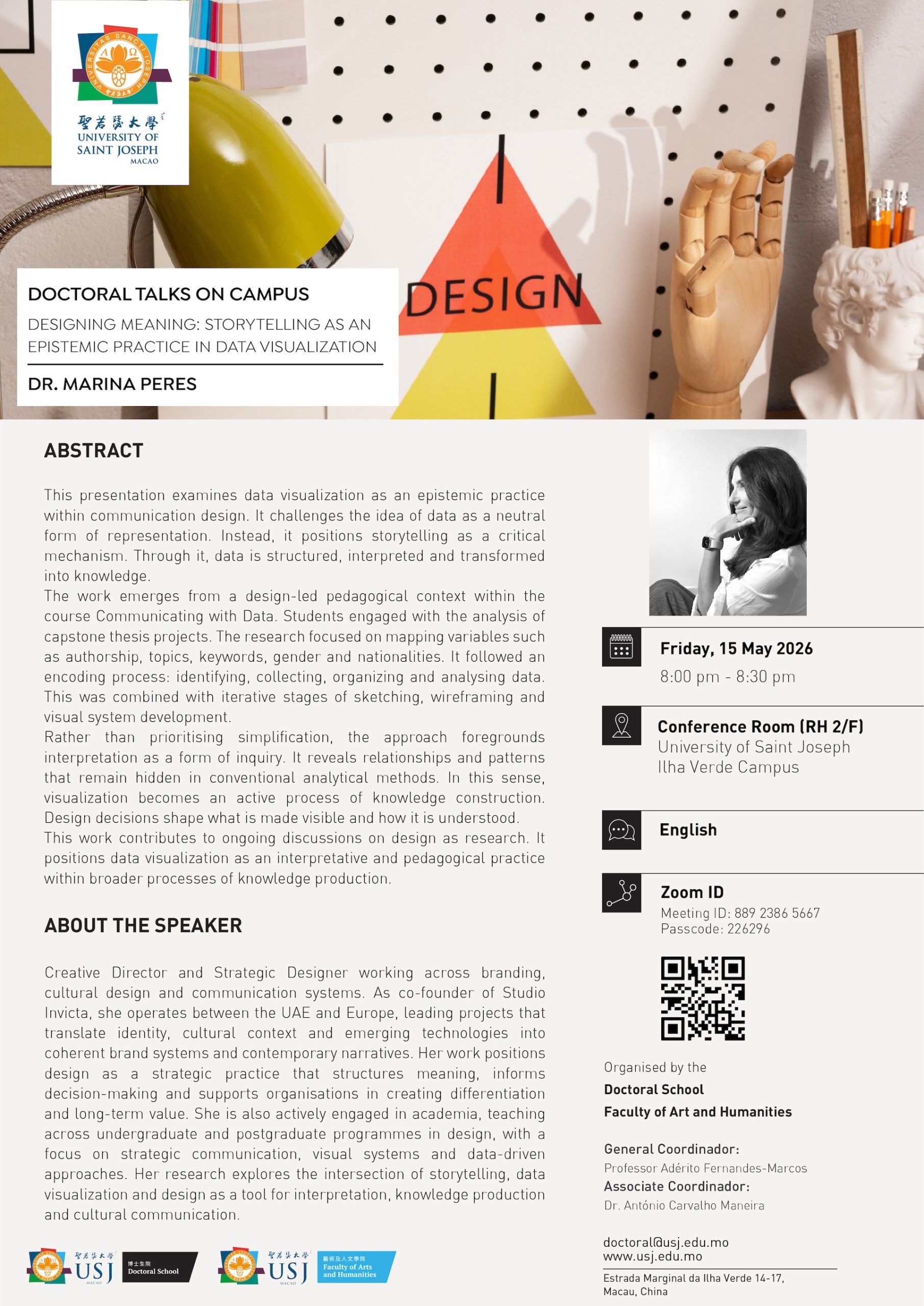
Designing Meaning: Storytelling as an Epistemic Practice in Data Visualization
Abstract:
This presentation examines data visualization as an epistemic practice within communication design. It challenges the idea of data as a neutral form of representation. Instead, it positions storytelling as a critical mechanism. Through it, data is structured, interpreted and transformed into knowledge.
The work emerges from a design-led pedagogical context within the course Communicating with Data. Students engaged with the analysis of capstone thesis projects. The research focused on mapping variables such as authorship, topics, keywords, gender and nationalities. It followed an encoding process: identifying, collecting, organizing and analysing data. This was combined with iterative stages of sketching, wireframing and visual system development.
Rather than prioritising simplification, the approach foregrounds interpretation as a form of inquiry. It reveals relationships and patterns that remain hidden in conventional analytical methods. In this sense, visualization becomes an active process of knowledge construction. Design decisions shape what is made visible and how it is understood.
This work contributes to ongoing discussions on design as research. It positions data visualization as an interpretative and pedagogical practice within broader processes of knowledge production.
About the Speaker:
Dr Marina Peres
Creative Director and Strategic Designer working across branding, cultural design and communication systems. As co-founder of Studio Invicta, she operates between the UAE and Europe, leading projects that translate identity, cultural context and emerging technologies into coherent brand systems and contemporary narratives. Her work positions design as a strategic practice that structures meaning, informs decision-making and supports organisations in creating differentiation and long-term value. She is also actively engaged in academia, teaching across undergraduate and postgraduate programmes in design, with a focus on strategic communication, visual systems and data-driven approaches. Her research explores the intersection of storytelling, data visualization and design as a tool for interpretation, knowledge production and cultural communication.
(PhD Candidates Presentation)
Curating as an Event of Knowledge: A Practice-Led Study of Relational Aesthetics and Social Integration in the Guangdong-Hong Kong-Macao Greater Bay Area (GBA)
Phd Candidate: Alice Kok
Abstract:
This research presents a practice-led inquiry into the role of Relational Aesthetics as a catalyst for social and identity integration within the Guangdong-Hong Kong-Macao Greater Bay Area (GBA). The study utilises the published curatorial anthology, Mind to Mind (2008–2025), as its primary longitudinal data repository for the Macao context. To broaden the regional scope, this doctoral project employs a comparative framework, incorporating site-specific case studies from Hong Kong and the Pearl River Delta. By analysing the “curatorial” as a reflexive “event of knowledge,” the research investigates how inter-human relations created through art address the inevitable frictions of regional integration.
Adopting a Grounded Theory methodology, the study investigates cross-border artistic collaborations to identify recurring thematic patterns of community resilience and belonging. To ensure methodological rigour across this multi-city dataset, the research implements AI-assisted qualitative coding to identify emerging thematic trends. The findings aim to provide a strategic model for using Relational Aesthetics to facilitate cultural cohesion and social mediation in rapidly evolving global urban clusters.