
USJ Doctoral Forum in History 2026
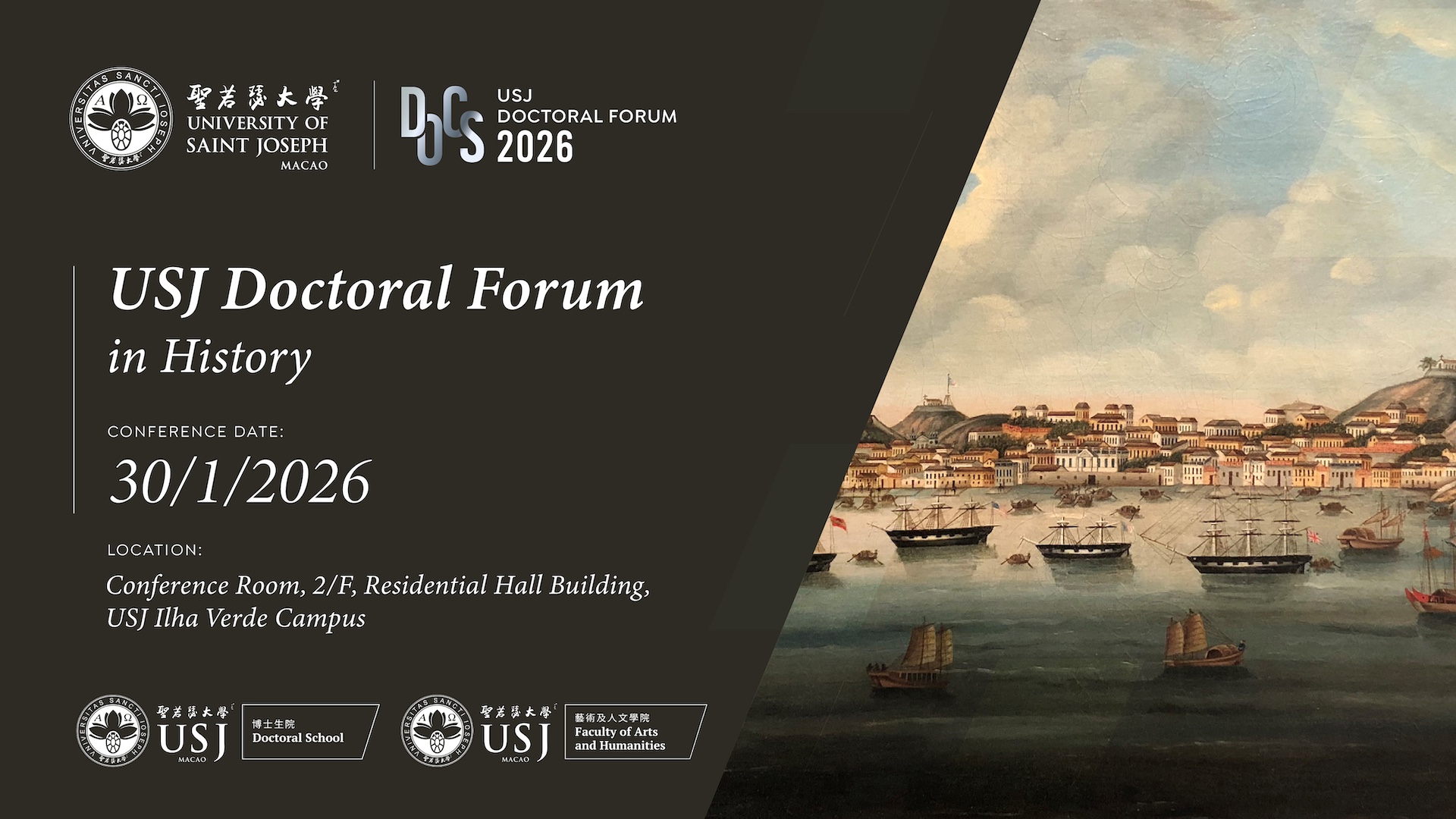
USJ Doctoral Forum in History 2026
30
Jan
The USJ Doctoral School and the Faculty of Arts and Humanities are organising a Doctoral Forum in the study/research area of History on Friday 30 January, from 7PM, in the Conference Room.
Programme Details:
Date: Friday, 30 January 2026
Time: 19:00 – 21:30
Location: Conference Room, 2/F, Residential Hall Building, USJ Ilha Verde Campus
Language: English
Organised by: Doctoral School and Faculty of Arts & Humanities
Contact: doctoral@usj.edu.mo
*Free event, open to the general public
Join with Zoom:
Passcode: 226296
Programme Rundown:
19:00 | Opening Address
- Dean of the Doctoral School Professor Adérito Marcos, and Dean of the Faculty of Arts and Humanities Dr. Carlos Caires
19:10 | Invited Speaker: Dr. Otis Edwards, The University of Hong Kong
-
Creative Constraints: How Commercial Barriers Fostered Financial Innovation in the Nineteenth Century Transatlantic China Trade
About the Speaker:
Dr. Otis Edwards is a business historian of global trade. His work focuses on how capital, commerce, and elite social networks shaped U.S.–China relations in the nineteenth century. Drawing on more than thirty years of experience in China’s manufacturing export sector, Dr. Edwards brings a unique perspective to the study of trade and finance. His research traces the links between London capital markets, U.S. monetary policy, and global commodity flows, while also exploring how Americans abroad managed reputation, wealth, and obligation within elite circles.
19:35 | Invited Speaker: Dr. Stacilee Ford, The University of Hong Kong
-
On Dealing with “Suspicious Sources”: Memoir, Movies, and Macau
In this presentation I reflect on several decades of research on “stories of self” as told through diaries, memoir and cinema. I will center autobiographical works by various individuals who, over more than two centuries, narrated their formative experiences in Macao. These narratives invite us to explore diverse connections between gender, national identity, ethnicity, and historical era. As we consider these case studies, we encounter some of the theoretical and methodological challenges involved in historicizing and analyzing cultural production. Cultural historians happily traverse various disciplinary boundaries although there are unique challenges in determining the veracity of the sources they research; nonetheless, these texts offer important historical insights, recuperate marginalized perspectives, and help us to think in fresh ways about the past.
About the Speaker:
Dr. Stacilee Ford has lived in Hong Kong since 1993. Originally from the U.S., she has degrees from Brigham Young University (B.A.), Harvard University (Ed.M), Teachers College, Columbia University (Ed.D), and The University of Hong Kong (Ph.D). She is Affiliate Associate Professor at the Faculty of Arts at The University of Hong Kong. She is a cultural historian who specializes in transnational U.S. history, and Hong Kong Cinema as global cinema. In all of her work she is interested in connections between micro (individual) and macro (national/transnational/global) histories. Building on her research on Hong Kong-U.S. connections and transformations in U.S. American and “Americanized” women’s lives, she is currently finishing a book on manhood, leadership, and Transpacific cultural production in the late 20th/early 21st centuries.
20:00 | Area Professor for History: Dr. Priscilla Roberts, University of Saint Joseph
-
The Search for Mary Allen Livingston Heard (1851-1882)
This presentation explores the difficulties, challenges, and occasional triumphs in trying to reconstruct the life and legacy (including her representations in artworks) of a woman who has almost disappeared from the historical record.
My interest in Mary Allen Livingston Heard began when I was doing research into visits to Macau by two royal Princes who later became brothers-in-law and good friends: Alfred, Duke of Edinburgh, who spent a day there in November 1869, and Grand Duke Alexei Alexandrovitch of Russia, fourth son of Tsar Alexander II, who spent a weekend in Macau three years later.
During repeated visits to Hong Kong and China in 1872-1873, Grand Duke Alexei became friendly with the businessman Albert Farley Heard, at that time Russian Consul in Shanghai, and his much younger wife, Mary Allen Livingston Heard. The friendship continued for some years, and it seems likely that in spring 1877 the Grand Duke and Mary Heard began a romantic relationship. Five years later, she died of tuberculosis in Paris, estranged from her husband and from some family members, who considered her a fallen woman, though others remained loyal. Her husband, who administered her estate, supposedly returned her personal papers to her family, since when they have disappeared.
Although numerous letters to and about Mary survive in the Heard Papers, and she wrote many letters herself, so far I have only found two documents written by her: a draft will from 1879, and a letter relating to the disposition of silver and other family possessions in 1878, both of them copies of an original. I thought it would be easy to track down a portrait of her by Thomas Buchanan, painted in early 1870 while she was on honeymoon in Italy, but the last record of this to date is when her husband gave it to her French maternal aunt, the Baroness de Boigne, in March 1884. She features in occasional letters from her father to her husband, and in letters written by Francis Blackwell Forbes, one of the rival Russell firm’s partners, during the 1870s. Although almost all refracted through external observers, taken together, these representations provide at least a partial picture of a woman who has previously been neglected.
About the Speaker:
Priscilla Roberts is Associate Professor of History and Heritage at the University of Saint Joseph, Macao. She received her bachelor’s and doctoral degrees from King’s College, Cambridge, and has taught and researched in Hong Kong and Macau. She has also held visiting research fellowships in the United States, the United Kingdom, and Australia. She has published extensively in modern international history, especially Asian-Western and Anglo-American relations. Since coming to Macau, she has developed a strong interest in the history of Macau, especially its global role.
She has produced 32 single-authored, edited, and co-edited books, and numerous journal articles and book chapters. Her latest book is Voices of World War I: Contemporary Accounts of Daily Life (New York: Bloomsbury Academic, 2023).
20:25 | Refreshment break20:50 | Panel Discussion and Q&A
21:30 | Closing Remarks