USJ Ceremony for the Conferral of Honorary and Higher Degrees 2025 | Speeches
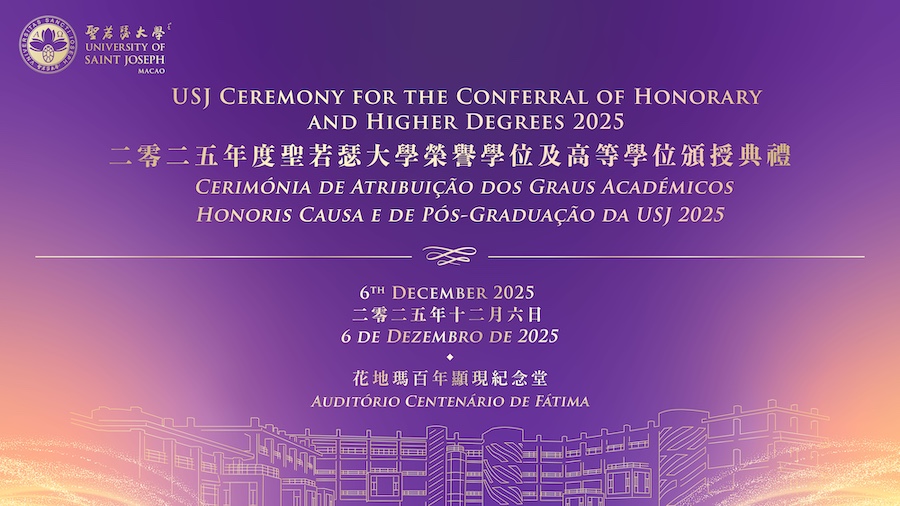
USJ Ceremony for the Conferral of Honorary and Higher Degrees 2025
二零二五年度聖若瑟大學榮譽學位及高等學位頒授典禮
Speeches | 致辭
Speech by Rev’d Prof. Stephen Morgan, Rector of USJ
校長麥侍文教授 致辭
English
(…)
The graduation of master degrees and doctoral degrees has always been the serious business at USJ. Indeed, for the first eight or nine years of USJ, all our degrees were master and doctoral degrees. In the last few years, however, as we expanded our offering to include undergraduate degrees, the bachelor degree ceremonies have assumed a greater importance.
Historically we used to have a single graduation ceremony in the summer for the students who were completing degrees at all three levels: bachelor, master and doctoral degrees. Three years ago, however, we moved to a system of having 2 ceremonies: those for master graduates and doctor graduates, and one for bachelor degrees. This allowed our masters and doctoral candidates students to complete the dissertations and theses defences in better time, under less pressure.
We added to these the award of degrees for candidates who were receiving degrees with doctoral degrees in recognition of the special honours: the graduates who were receiving their higher doctoral degrees with the grant by cause of specific honour.
Today we award a Doctorate of Divinity honoris causa to my predecessor, as Rector, Fr Peter Stilwell, for the particular honour due to him for his long-standing status as a distinguished theologian and educator. We also award a Doctorate in Business Administration Mr Lucas Lo, in recognition of his long-standing involvement in the university which has enabled us to develop the university library and other facilities, in part in honour of his late father, Guillermo Lo and in part to his mother Mrs Teresa Lo, who, I am delighted to say is able to honour us with her presence with us today.
The detail of the honours that they bring to the university, and which the university recognises, will be read by the presenting deans and it is not any part of my task to repeat the text of the laudatio. The honourands themselves will both speak in recognition of the award of their honorary doctorates, but I want to make a few remarks of my own to thank both Lucas and Father Peter for their distinguished service to the University of Saint Joseph and the delight it brings me to recognise that honour on behalf of the university.
It is now 5 1/2 years since I became Rector of USJ. When I became Rector, the Bishop gave me three very specific tasks. The first was to complete the accreditation of all the university’s programs in accordance with the Macau Higher Education Law. This required an immense amount of work in the field of quality assurance. My former vice rector, Keith Morrison, assisted by Lavena Cheong and the excellent staff of the QA office, worked through 38 programmes, dealing with a number of different independent QA agencies from all over the world, some of whom understood, some of whom did not, the nature of the programmes that we were seeking to accredit. Earlier this year, we finally got through the process, including the doctoral program and its 10 specialisms. We now look at our programmes with confidence, knowing that they are of the highest quality and meet the highest international standards.
The second task that the chancellor gave me was to complete the university’s affiliation to the Faculty of Theology at UCP. This was necessary to ensure that our students for the priesthood and religious life would have qualifications that were transferable between all and any ecclesiastical faculties across the world. Thanks to the work of Fr Franz Gassner, Fr Cyril Law and the team at the Dicastery for Culture and Education at the Vatican, this has now been completed.
Finally, USJ had one overarching goal and that was to secure permission to admit students to our programmes from mainland China. In my second year as rector we managed to obtain a limited and trial permission to admit 30 postgraduate students from four areas of study, from Gwangzhou, Shanghai and Beijing. At the end of that period of trial, we were encouraged by the Ministry of Education of the Central People’s Government in Beijing to apply for a larger permit, covering all provinces in China, and most of our 17 postgraduate programmes. It has been a nervous period, since it was not clear to us what we had to do to meet the requirements, or how long the decision would take. We were greatly assisted through this process by the Education Bureau, DSEDJ, and I am delighted to inform you that we have just learned that we will be granted a recruitment permit for next year and beyond, for 160 master students and 30 doctors students per year, across our postgraduate programme, recruiting from all provinces in China and not restricted to those students who have recently graduated. This is tremendous news and should mean that by the third or fourth year of recruitment, fully one third of the students in the university will be from mainland China. This meets our target of the university comprising approximately one-third of our students from Macau, one-third of our students from international destinations, and one-third of our students from mainland China.
This will enable us to have a student body, comprised, as I had always wished, of students from China, for China and of China. USJ truly a university in China, of China, from China.
I want to give particular thanks to the staff of DSEDJ, the Liaison Office of the Central People’s Government in Macao and to the Ministry of Education of the Central People’s Government in Beijing for placing their trust in us to permit this to happen. I should also wish to express my gratitude to the Bishop and the Diocese of Macau for all their support in this process, for all the hard work of many people in the university, and particularly to my vice rector, Zhang Shuguang, who joined the university with this very specific task in mind. Well done, Shuguang. It will be, I believe, transformational. It marks the beginning of a new era at USJ and gives me particular delight.
With the expansion of the quota, this should mark a new phase in the future of USJ: one that it is truly fitting that we mark with the award of today’s degrees honoris causa and celebrate the magnificent achievement of today’s 95 master’s and 8 doctoral graduates. Congratulations to you all.
中譯 (翻譯)
(…)
聖若瑟大學一直將碩士和博士學位的畢業典禮視為重要盛事,的確,在大學成立的頭八、九年間,我們所有頒發的學位皆為碩士及博士學位課程。然而,近年隨著我們擴展至提供學士學位,學士學位的畢業典禮開始承擔更大重要性。
過去,我們習慣在夏季舉辦一次涵蓋全部學位的畢業典禮:學士、碩士及博士學位。然而,三年前,我們改為舉行兩場典禮,分別為碩士及博士畢業生的典禮及學士學位典禮。此舉讓碩博士生能更從容地完成論文答辯,減輕壓力。
此外,我們增設榮譽學位的頒授,以表彰那些因傑出成就而獲得博士學位的畢業生,以榮譽原因獲頒高等博士學位畢業生。
今日,我們授予前任校長薛沛德神父榮譽神學博士學位,以表彰他作為傑出神學家與教育者的長期貢獻。我們亦授予羅掌權先生工商管理博士學位,以肯定他長期參與本校發展,包括圖書館及其他設施的努力,部分旨在紀念其已故父親羅志國,也部分獻給他的母親羅李靈貴女士,我很榮興今天她能親臨典禮。
所屬院長將宣讀他們為大學帶來的細節,獲頒榮譽博士學位的嘉賓將分別致詞感言,而我亦欲藉此機會,向羅掌權先生與薛沛德神父表達謝忱——感謝二位對聖若瑟大學的卓越貢獻。能代表本校授予此項殊榮,我深感榮幸。
我成為校長已有五年半時間。當時,主教交付我三項具體任務。首先是依據澳門高等教育法律完成全校所有課程的認證,在品質保證領域需要龐大工作,我的前副校長祈務晨教授,連同張潔瑜女士及優秀數質保證辦公室同事協助下,完成一共38個學程的認證,與來自全球多家不同獨立機構合作。早在今年,我們終於完成這一過程,包括博士課程及其十個專業方向。如今,我們有信心地看待所有課程達到最高國際標準。
第二項任務是完成和葡萄牙天主教大學神學院的隸屬關係,以確保神職及修道生的學位資格在全球所有教會神學院間的學分轉移,感謝範聖言神父、羅偉傑神父及梵蒂岡文化與教育部團隊的努力,這項任務已成功完成。
最後,聖若瑟大學有一重大目標,即取得從中國內地招生許可;在我任期的第二年,大學獲得試行招生資格,限定招收30名來自廣州、上海、北京四個學科領域的研究生。在試行結束時,北京中央政府教育部鼓勵我們申請更大範圍的招生許可,涵蓋中國所有省份及大多數17個研究生學程。這期間充滿挑戰,我們不確定必須符合何種要求或等待多長時間。期間,澳門教育及青年發展局提供大力協助。我十分高興宣布聖大剛獲准未來年度招生許可,每年招收160名碩士及30名博士研究生,覆蓋所有研究生學程,招生範圍擴及全中國,不限於應屆畢業生。這是重大好消息,預計於招生第三、四年,校園學生中將有約三分之一來自內地,此目標使本校學生構成約三分之一本地生、三分之一國際生及三分之一內地生。
這將讓我們構建一個由中國學生組成、為中國服務、屬於中國的學生團體。聖若瑟大學真正成為一所在中國、在中國、屬於中國的大學。
特別感謝教育青年及發展局、中央人民政府駐澳門聯絡辦公室以及北京中央政府教育部信任支持,促成此事。我亦感謝澳門教區主教與教區在此過程中的全面支持,感謝校內多位同事,尤其是專責此事項而加入的副校長張曙光教授,辛苦了。我相信標誌著聖若瑟大學開始新的里程碑,讓我倍感欣慰。
學額擴大後,這將開啟大學嶄新發展階段,今日榮譽學位授予,包括8名博士生、95名碩士的卓越學術成就即是最佳見證。恭喜大家。
Speech by Prof. Peter Stilwell | Doctor of Divinity Honoris Causa
薛沛德神父 致辭 | 榮譽神學博士學位
English
(…)
Allow me to start by thanking Bishop Stephen Lee, Chancellor of this University of Saint Joseph, the Rector, Rev Stephen Morgan, and the other members of the University’s General Council, for awarding me the degree of Doctor of Divinity Honoris Causa. The award is granted to me personally, but I see it as the recognition of much dedicated teamwork that, over eight critical years, allowed us to consolidate an institution initially dreamt of by Bishop Domingos Lam and set up by the founding Rectors of IIUM and USJ, Professors João Lourenço and Ruben Cabral.
I would like to take this brief opportunity to address the unuttered question in many peoples’ minds: why does the Catholic Church dedicate so much time, effort and resources to Education – from primary schools to universities? Why, for example, did the Jesuits set up the College of Saint Paul, 432 years ago, just twenty years after the Portuguese were allowed to settle in Macau? Why – given that less than 5% of Macau’s residents are Christians, let alone Catholics – does the Catholic Church run 40+% of the region’s primary and secondary school network, plus a Seminary and a University? If the aim is to recruit new members for the Catholic Church and form its clergy, one might be forgiven for considering the endeavour singularly unsuccessful. The question is not, however, limited to Macau. The Catholic education network is a worldwide enterprise, and the number of its institutions at every level surpasses that of most countries.
To unpack this issue, I would like to step back to the origins of Christianity.
Much has been said, this year, about the Council of Nicaea. Just this week, Pope Leo and Patriarch Bartholomew, with many leaders from other Christian denominations, visited the ruins of an ancient basilica, built in a beautiful setting, beside Lake Iznik in modern Türkiye, to commemorate the First Ecumenical Council, held there 17 centuries ago. It was convened in the year 325 of the Christian (or common) Era by the Emperor Constantine, who had just taken control of the whole of the Roman Empire. The theological debate it was called to resolve concerned the divinity of Jesus. There is, however, another question that has long intrigued me. Why did Constantine, who was not at that time a baptised Christian, convene all the bishops in the Empire and beyond? In the Eastern regions of the Mediterranean, the theological controversy was tearing Christian communities apart, but Constantine had previously dealt with the issue by strongly advising Christians, by letter, to leave such subtle theological discussions to philosophers.
We would be wrong to discard Constantine’s interest in the Church as “family business”. True, his mother was a Christian, and one of his most trusted advisers was the bishop of Cordoba, but Constantine was a brilliant strategist and a hardnosed politician, not guided by sentiment. A year after the Council, he had his second wife and his eldest son put to death for allegedly having an affair.
So, what was it that Constantine saw in Christianity that he felt would further his aim to restore unity and purpose to the Roman Empire?
The third century had seen some 25 emperors rise and fall in rapid succession. One hundred years of mismanagement, civil strife, migration, and repeated waves of disease and famine had left the once proud Empire on the brink of collapse. Finally, at the turn of the century, Emperor Diocletian (284-305 AD) took control, reformed the shattered State, and attempted to reintroduce traditional Roman civic and religious customs. That partly explains why he also unleashed the most violent persecution yet against Christians. But why single out the Christians from among the endless religious movements in the Empire? What both Diocletian and Constantine saw, in my opinion, but interpreted so differently, was the extensive network of Christian communities, covering the whole Empire, bound not by any rigid organizational structure, but by something more subtle: what, many centuries later, the French writer Charles Peguy would call la grande Amitié (the great Friendship, or Kindness). Diocletian saw this as a threat to his autocratic control of the Empire. Constantine saw it as the mortar on which he hoped to lay the bricks of a new order: an Empire that would eventually flourish as a Christian civilization.
I believe, however, we can dig a little deeper. From the Christian writer Lactantius, and from Eusebius, Bishop of Caesarea, contemporaries and profound admirers of Constantine, we learn that it was not he but his onetime colleague and rival, Galerius – not a nice man, by all accounts, and given to violent rages –, who suddenly abandoned a lifelong and passionate opposition to Christianity by publishing in Serdica, in the year 311, an Edict of Toleration, effectively ending all persecution of Christians. Two years later, Constantine and Licinius would extend this new freedom of worship to every region of the Empire, by the more often quoted Edict of Milan. But the question remains: why the sudden change of heart by Galerius? And there it is, in the edict! Galerius was dying from some painful form of bowel cancer, and he begs the Christians to pray for him. Even for him, their onetime archenemy, Christians are somehow linked to kindness and care.
Released by Galerius “from the misery of the mines”, Christians now returned to their homes. “Long columns of men and women went on their way, singing psalms and hymns of praise to God in the middle of the highways and city squares” – Eusebius tells us –, and fellow citizens “shared our joy at what was happening”[1]. Christians, in fact, were popular – which was probably a good part of the reason why, in a troubled Empire, many civil authorities saw them as a threat. From Eusebius, a few pages further on, we learn of one of the reasons. A sudden outbreak of “pestilence and famine” swallows “whole families in a few moments”. Then “the fruits of the Christians’ limitless enthusiasm and devotion became evident to all. Alone, during this terrible calamity, they proved by visible deeds their sympathy and humanity. All day long some continued without rest to tend the dying and bury the dead […]; others rounded up the huge number who had been reduced to scarecrows all over the city and distributed loaves to them all, so that their praises were sung on every side, and all men glorified the God of the Christians and owned that they alone were pious and truly religious: did not their actions speak for themselves?”[2]
And there we have it, in a nutshell. Christian communities might be seen as a threat to many traditional Roman customs, and to the absolute claims of Imperial autocrats, but there was a grudging, and at times overt, admiration for their kindness and care. In the words of the second century Epistle to Diognetus: “what the soul is in a body, Christians are in the world”.[3]
This was no accident. Loving kindness[4] was the distinguishing feature of Jesus of Nazareth. Not just because he was of a sociable or friendly disposition. But because gentleness and care were what he lived and taught. Dangerously so! One has only to read his great parables – the Prodigal Son, the Good Samaritan, or the Last Judgment, for example – to understand that the seven corporal and seven spiritual works of mercy in our Catechism are not optional extras but lie at the very heart of the religious experience that Jesus lived and proposed. In his loving kindness and care lay the deepest understanding of who he was: the “logos” who casts light and meaning on all that exists. And so, we return to Nicaea. In this Jesus did not simply inform us about God, but revealed that he was – and is – one in nature with the Father.
Caring for the hungry, the thirsty, the homeless, the sick; learning and listening in hope for a meeting of minds; sowing love for creation, and seeds of forgiveness and peace in times of trouble… Is the life-changing experience that flows directly from Jesus’ command: “Do this in memory of me!”. At the heart of every Eucharistic celebration lies the root cause of the pilgrim hospices, care homes and leprosaria set up by Christian communities; from there also flowed the passion for truth and education that gave rise, in the Eastern Mediterranean, to the great schools of Alexandria, Antioch and Caesarea, and in Western Europe to the early monastic and cathedral schools, and then the universities of Bologna, Paris, Oxford, Salamanca and Coimbra. There also lay the reason why Valignano, Ruggieri and Ricci, after shedding the initial impulse of European political and economic expansion, learned to value the depths of Chinese culture and initiated an ongoing dialogue based, not on self- or group-interest, but On Friendship[5] and a joint care for the well-being of all.
[1] Eusebius, The History of the Church from Christ to Constantine, Penguin Books Ltd. (Kindle Edition), (p. 284)
[2] Eusebius, The History of the Church from Christ to Constantine, Penguin Books Ltd. (Kindle Edition), p. 291
[3] Epistle to Diognetus, Grapevine Press (Kindle Edition), p. 11.
[4] The Greek term agápe, considered by Paul to be the greatest of God’s gifts (1 Cor 13), may originally have denoted the loving kindness of a mother for the child in her womb. In the Apostle’s mind, however, it probably evoked the Hebrew term hesed, or God’s covenantal love for his people, namely when he tells the Romans that nothing “can separate us from the agápes of God in Christ Jesus our Lord” (Rom 8,39). 1 Jo 4,16 goes a step further and affirms that God himself is love (Theos agápe estín).
[5] Title of Matteo Ricci’s landmark book, On Friendship: One Hundred Maxims for a Chinese Prince (1599).
中譯 (翻譯)
(…)
首先,請容許我衷心感謝聖若瑟大學校監李斌生主教、校長麥侍文教授,以及大學校董會各位成員,授予我「神學榮譽博士」(Doctor of Divinity Honoris Causa)學位。這項榮譽是頒給我個人,但我認為更是對過去八個關鍵年頭裡無數人同心協力、默默耕耘的肯定——正因這份團隊努力,我們才得以鞏固一所最初由林家駿主教夢想、並由澳門高等校際學院與聖若瑟大學創校校長João Lourenço教授及Ruben Cabral教授共同創立的學府。
趁此短暫機會,我想回應許多人心裡沒有說出口卻一直存在的疑問:為什麼天主教會投入如此龐大的時間、精力與資源在教育事業上——從小學到大學皆然?例如,為何耶穌會早在432年前、即葡萄牙人獲准在澳門定居僅20年後,就創辦了聖保祿學院?為何在澳門居民中基督徒(更不用說天主教徒)不到5%的今天,天主教會仍承擔了澳門超過40%的幼稚園、小學及中學網絡,並且開辦了一所神學院及一所大學?若純粹以招收教友或培育神職人員為目標,這項事業似乎可以說是「極其不成功」。這個問題並非澳門獨有。天主教的教育網絡是全球性的事業,其各級學校數量之多,超過了世界上大多數國家。
要解答這個問題,我想把時間拉回到基督教的源頭。
今年對尼西亞公會議的討論眾多。就在本週,教宗良十四世與牧首巴多羅買及多位來自其他基督教教派領袖一同踏訪土耳其伊茲尼克湖畔那座建於美麗環境中的古老大教堂遺址,以紀念十七世紀前於此地召開的第一屆大公會議。
該會議於公元325年,由剛剛掌控整個羅馬帝國的君士坦丁大帝召集,旨在解決有關耶穌基督神性的神學爭議。然而,令我長期深思的一個問題是:當時尚未受洗成為基督徒的君士坦丁,為何會召集帝國內外所有主教?
在地中海東部地區,神學爭論正撕裂基督教社群,但君士坦丁此前通過書信嚴正勸告信徒,應將這些複雜的神學討論留給哲學家解決。我們不能輕易將君士坦丁對教會的興趣僅視為“家族事務”。誠然,他的母親是基督徒,且他的近身顧問之一為科爾多瓦主教,但君士坦丁是深謀遠慮且務實的政治家,決不受情感支配。會議召開一年後,他因傳聞妻子與長子不忠,遂將兩人處死。
那麼,君士坦丁在基督教身上看到了什麼,令他相信基督教將有助於恢復羅馬帝國的團結與使命?三世紀期間,約有二十五位皇帝短暫登位又迅速垮台。一百年的管理失當、內亂、人口遷徙,以及瘟疫與飢荒不斷襲擊,使這個昔日輝煌的帝國瀕臨崩潰。
最終,公元284年至305年執政的戴克里先皇帝掌權,重整破敗的國家,試圖恢復羅馬傳統的市民與宗教習俗,這亦解釋了他為何展開史上最嚴厲的基督徒迫害。
但為何基督徒會被從眾多宗教運動中挑出來?戴克里先與君士坦丁所看到的,是覆蓋整個帝國的基督教社群網絡,並非基於嚴格組織架構,而是一種更為微妙的紐帶,法國作家查爾斯·佩吉數百年後稱之為「la grande Amitié」(偉大友情)。
戴克里先視此網絡為他專制統治的威脅,而君士坦丁則將其視作打造新秩序的基石,建立一個基督文明日後得以蓬勃發展的帝國。我們可以更深入探究。基督徒作家拉克坦修斯及卡薩里亞主教尤西比烏斯——他們是君士坦丁的同時代人且敬佩他——記載,非君士坦丁本人,而是他的同僚兼對手加萊里烏斯,在311年於塞爾迪卡頒布了容忍法令,終止對基督徒的迫害。
兩年後,君士坦丁與利錫尼烏斯通過更為人熟知的米蘭敕令,將宗教信仰自由推廣至全帝國。但問題仍在:為何加萊里烏斯忽然改變立場?敕令揭示答案:加萊里烏斯正飽受腸癌之苦,懇求基督徒為他禱告。即使對他這位昔日大敵,基督徒依然被賦予了仁愛與關懷的象徵。
在加萊里烏斯解除“礦山苦工”後,基督徒重返家園。尤西比烏斯描述:「長長的人龍在大路與廣場中央一邊行進,一邊唱著詩篇和讚美神的聖歌。」同時,市民共享這份喜悅,基督徒實際上很受歡迎。
這可能也是動盪的帝國中,許多地方政府將他們視為威脅的原因之一。尤西比烏斯揭示另一成因:突如其來的瘟疫與饑荒,短時間內奪去整個家庭的生命。而基督徒無限的熱誠與奉獻,則在災難中顯露無遺。他們不眠不休地照料垂死者和掩埋亡者;有人則收集城市中被饑餓折磨得如同稻草人的眾多難民,分發食物,贏得四面八方讚頌,他們的行動令所有人讚美基督的神,並認同基督徒是唯一虔誠且真正敬畏神的群體,行動本身說明了一切。
至此我們明白,基督教社群雖被視為挑戰羅馬傳統習俗及皇帝絕對權威,但他們的仁愛與照顧獲得了或多或少尊重,甚至公開讚賞。正如二世紀《致底奧格尼圖斯書》所言,「基督徒在世上的作用,如同靈魂之於身體」。這並非偶然。愛與慈悲是拿撒勒人耶穌的鮮明特質,不僅因為他性格和藹,而是溫柔與關懷構成了他的生命和教導的核心,十分危險!通讀他的寓言,如浪子回頭、好撒瑪利亞人、末日審判等故事,我們可見教理中七件身體和七件靈性仁愛工作,並非附加選項,而是耶穌生活和提倡信仰體驗的核心。
耶穌的愛與慈悲深刻地表明了他是誰:那位為萬物帶來光明與意義的「道」(Logos)。因此,我們再次回到尼西亞。耶穌不僅向我們揭示了神的存在,更彰顯他與天父在本質上的合一。照顧飢餓、口渴、無家可歸及病患的人;懷著希望學習與傾聽,尋求心靈的契合;在困境中播種愛、寬恕與和平的種子……這就是耶穌所命令「為記念我做這事」的生命蛻變經驗。
每一次聖體禮儀的核心,正是基督徒社群興建朝聖醫院、護理院及麻風病院的根源;自此,亦激發了東地中海亞歷山大、安提阿及凱撒利亞等地著名學校的誕生,以及西歐早期修道院、教堂學校,並拓展成為波隆那、巴黎、牛津、薩拉曼卡與科英布拉諸大學。這亦是瓦利尼奧、魯吉耶里與利瑪竇在放下歐洲政治經濟擴張初衷後,開始欣賞中國深度文化,不是基於自身或群體利益,而是基於友誼,及共同關懷人類福祉的持續對話。
Speech by Dr. Lucas Lo | Doctor of Business Administration Honoris Causa
羅掌權博士 致辭 | 榮譽工商管理博士學位
English
(…)
Today, I am honoured to receive this Honorary Doctorate in Business Administration from the University of Saint Joseph of Macau. It is also a great blessing to receive it from the hands of Rector Stephen Morgan and from Your Excellency, Bishop Lee. To be recognized in this way by a Catholic university is extremely encouraging for me. This is the highest affirmation of my life’s work as a businessman, a journey rooted in faith, family, and service.
My first and greatest teachers were my late father, may he rest in peace, and my mother, who is with us today. As lifelong Catholics, they did not just talk about their faith; they lived the Gospel through their daily prayers, constant acts of kindness, their volunteer work at our Church, and their readiness to help anyone in need. They showed me what it means to serve; they instilled in me the belief that true self-fulfilment comes from serving others.
These values I learned at home became the foundation of my career. While business often prioritizes profit above all, I have always believed that business, at its best, is a calling to serve others. The famous saying “If you want others to be happy, practice empathy; if you want to be happy, practice empathy” has always felt like a personal truth. I firmly believe that business can be a powerful tool for good, a platform for positive change, and a place where we use our influence and resources to truly serve our community.
For me, this philosophy finds its most profound meaning in supporting education. I view education as the most powerful form of charity because it offers a long-term solution; it not only unlocks a person’s potential and gives them the skills to improve their own life, but this empowerment, also, creates a cycle of gratitude, as those who have been helped are inspired to help others. And in doing so, it is my way of honouring the investment you mom and our beloved father made in me, your most incredible gift.
Soon, many of you will be leading your own businesses. You will hear people say that business is a cold, heartless game, where the only goal is to maximize profit and get rich. I hope you see this for what it is: an empty way of thinking. This view overlooks the communities we can build, the problems we can solve, and the lives we can positively impact. My own journey has taught me that a business is among the most powerful tools for human collaboration ever created, a vital network of energy, talent, and dreams. When you choose to run your business with strong ethics, you transform it. Your future enterprise will be the ultimate platform for your values. Use it to prove that the most successful businesses are not those with the most significant profits, but those that leave the most profound, positive mark on the world.
My journey, so far, has been one of trying to align my professional life with my personal faith. It has been about doing business “My Way”, a way that follows the Church’s social teachings in the business culture. This award from the Catholic University of Saint Joseph is an encouraging affirmation of that effort, and it challenges me to prove that an ethical, faith-driven business model is both possible and worthy of pursuit.
As I bring my remarks to a close, I would like to offer my most sincere thanks to Your Excellency, Bishop Lee, for your spiritual guidance and for presiding over this ceremony. My thanks to Reverend Rector Stephen Morgan for his visionary leadership and for this tremendous honour. My deep gratitude to our dedicated faculty, administrative staff, and supporting teams. To my beloved family, and to all of you here today. Your presence has made this ceremony more meaningful to me.
And now, allow me to sing a few lines from a popular song, “My Way” by Frank Sinatra, which captures the spirit of living with this purpose and faith:
“Regrets, I have had a few,
But then again, too few to mention.
I did what I had to do,
And saw it through without exemption.
I planned each charted course,
Each careful step along the byway,
And more, much more than this,
I did it my way”
Thank you! May God bless you, and may He forever watch over the University of Saint Joseph.
中譯 (翻譯)
(…)
今日,我深感榮幸獲頒澳門聖若瑟大學頒授工商管理榮譽博士學位,此殊榮由麥校長及李主教閣下親自頒贈,並蒙二位親自見證,能獲天主教大學肯定,令我倍感鼓舞,必然是對我從商畢生事業的嘉許 — 這段旅程紮根於信仰、家庭與服務精神之中。
我最初的啟蒙老師,同時也是我最偉大的導師,乃是已故的父親 — 願他安息,以及至今仍健在的母親。身為終生奉行天主教信仰的信徒,他們不僅口頭傳承信仰,更透過每日祈禱、持續行善、在教會的志願服務,以及隨時準備幫助有需要的人,身體力行地實踐福音精神;他們為我示範為他人服務的意義,更使我深信:真正的自我實現,源於服務他人。
父母的教誨成為我職業生涯的基石,即使利潤在商業世界中為首要考慮,但我始終堅信:理想的商業本質,是服務他人的使命召喚。有一句名言「若想他人快樂,請實踐同理心;若想自己快樂,請實踐同理心」為我的座右銘:我堅信商業能成為行善的強大工具、推動正向變革的平台,而是運用影響力與善用資源到真正服務社群的領域。
教育提供長遠解決問題的途徑,因此,我視其為最具影響力的慈善形式。教育不僅能釋放人們的潛能,還能賦予他們改善生活的技能,並創造出感恩的循環—激勵受助者去回饋他人。這份實踐正是我對母親和摯愛父親的致敬—他們賜予了我最珍貴的禮物。
不久將來,你們當中許多人將成為自己事業的領導;你們會聽見人們說,商場是冰冷無情的遊戲,唯一目標就是利潤最大化、致富。我希望你們能看清這不過是種空洞的思維方式。這種觀點忽視我們能建立的社群、能解決的問題,以及能積極影響生命。自身經歷教會我:企業遠不止於商業實體;商業是人類創造史上最具力量的合作工具之一,是能量、才華與夢想交織的關鍵網絡。然而,這個網絡需要靈魂、需要使命。這正是你們的價值觀發揮作用之處,當你們堅定地選擇以道德準則經營事業,便能賦予企業蛻變的力量;你所堅信的價值觀將成為未來企業的終極舞台,並用它來證明:最成功的並不是最獲利最豐富的,而是那些為世界留下最深遠、最深刻印象的公司。
直到今天,這趟旅程仍然堅持嘗試結合職業生涯與個人信仰,以「我的方式」經商,遵循教會社會教義在商業文化中的實踐,聖若瑟大學授予此殊榮,不僅是對這份努力的肯定,更使我深信:以信仰為動力的商業模式,不僅可行且值得追求。
最後,我謹向李主教閣下致上最誠摯的謝忱,感謝您在精神層面的指引及主持是次典禮。同時感謝麥校長遠見卓識,以及授予我這項無上榮譽;謹向全體敬業的教職員、行政團隊及支援人員致上深切謝忱。致我摯愛的家人,以及今日在場的各位,你們的參與令這場典禮對我更具意義。
此刻,容我吟唱幾句法蘭·仙納杜拉的經典名曲〈我的方式〉,這首歌完美詮釋了懷抱信念與目標而活的精神:
「遺憾,我確實有過幾次,
但說到底,微不足道。
我做過該做的事,
從不退縮,貫徹始終。
每條航線我都精心規劃,
每段小徑都謹慎踏實,
更重要的是,
我始終走自己的路。」
感謝您們!願上帝賜福於您們,並永遠守護聖若瑟大學。
Speech by Kelvin Leong Ka Hou | PhD in History
學生代表 梁嘉豪 致辭 | 歷史學博士學位
English
(…)
Good afternoon Rector, professors, distinguished guests, colleagues, family, and friends.
My name is Kelvin, PhD in History, and I am honoured to stand here on behalf of the graduating class.
Today, we gather to celebrate the culmination of many years of persistence, and intellectual curiosity. This moment represents countless hours of reading, writing, questioning, and rethinking. It represents the relationships we built with our supervisors, professors, and peers, who guided us, challenged us, and helped us grow. And it reflects the support of families and friends who stood beside us during the most difficult moments.
For all of us, completing a PhD is far more than an academic title. It signifies a journey of resilience — a journey where we learned not just to find answers, but to ask better questions; not just to follow knowledge, but to create it. As we leave this stage and step into the next chapter, we carry with us the responsibility to use what we have learned to contribute meaningfully to our communities, our fields, and the next generation. Whether we continue in academia, join industry, enter public service, or explore new opportunities, we share the same foundation: the courage to think deeply, grow continuously, and challenge the world around us.
Now, please allow me to share a little of my own journey.
From the time I was in kindergarten, I already wanted to become a teacher. Even at that age, I was fascinated by how knowledge could shape a person’s way of seeing the world. Today, as a lecturer at the Macau University of Tourism, I am grateful to be living that dream — guiding young minds and passing knowledge to the next generation has become the greatest joy of my life. USJ provided me with the freedom and flexibility to shape my thesis, encouraging me to follow my own academic instincts. This environment strengthened my self‑discipline and independent thinking, becoming a catalyst for my growth as a researcher.
One thing about me has never changed: I am not a “yes man,” and I was never a “yes kid.” I have never believed that true knowledge is something to be accepted passively. It is not something handed to you. The truths and the real understanding must be explored, questioned, and discovered through one’s own curiosity and effort. This belief has guided me throughout my academic path and made the pursuit of new knowledge deeply satisfying.
And even though I am standing here today with a PhD, I do not see this as the final destination of my academic life. If anything, this milestone only reinforces my desire to keep learning, keep exploring, and keep growing.
Of course, none of us reached this stage alone. I would like to express my heartfelt thanks to the people who stood by me throughout this journey — my grandfather, my sisters, my friends, my partner and of course, my supervisors. Your encouragement, patience, and belief in me made all the difference.
To my fellow graduates: today, we celebrate not just what we have achieved, but who we have become. We have proven that perseverance can overcome doubt, that curiosity can overcome uncertainty, and that learning remains a lifelong pursuit.
Congratulations to the graduating class. May we continue to explore, question, and contribute with the same passion that brought us here today. May your journey ahead be bold, meaningful, and filled with new discoveries.
Thank you.
中譯 (翻譯)
(…)
校長、各位教授、貴賓、同學們、家人及朋友們,下午好,
我是梁嘉豪,很榮幸能代表本屆畢業生在此致辭。
今天,我們齊聚一堂,共同慶祝多年堅持與求知之旅的豐碩成果。此刻凝聚了無數小時的閱讀、寫作、提問與反思,見證了我們與導師、教授和同儕建立的深厚情誼——是他們引導我們、激發我們、陪伴我們成長。此刻更承載著家人朋友們始終如一的扶持,在每個艱難時刻給予我們最溫暖的依靠。
對我們所有人而言,完成博士學位遠不止獲得一個學術頭銜,它象徵著一段淬煉心智的征程——在這段旅程中,我們學會的不僅是尋找答案,更是提出更深入的問題;不僅是追隨知識,更是創造新知。當我們離開這個舞台,邁向人生的新篇章,我們肩負著運用所學, 為社會、專業領域及下一代作出實質貢獻的責任。無論是深耕學術、投身專業領域、服務公眾或開拓新方向,我們都共同擁有那份勇於深度思考、持續成長並積極挑戰世界的膽識。
請容許我在此分享一些個人體悟。
從幼兒園時期開始,成為教師便是我心中的夢想。即便在那樣懵懂的年紀,我已著迷於知識如何重塑一個人觀看世界的方式。如今作為澳門旅遊大學的講師,我感恩能實踐這個夢想——引導年輕心靈、將知識傳遞給下一代,已成為我生命中最深刻的喜悅。聖若瑟大學給予我充分自由與彈性來寫作我的論文,鼓勵我追隨自己的學術直覺。這樣的環境強化了我的自律與獨立思考能力,成為我作為研究者成長的重要契機。
當中始終未變的是,我從不是個唯唯諾諾的人。我從不相信真正的知識能被動接受,也非他人所能贈予。真理與真正的理解,必須透過個人的好奇心與努力去探索、質疑與發現。這份信念貫穿了我的學術之路,使追求新知的過程充滿了滿足感。
即便今日我已取得博士學位,我並不視此為學術生涯的終點。相反,這個里程碑更堅定了我持續學習、探索與成長的渴望。
當然,我們無人能獨自抵達這個目標。我要衷心感謝這趟旅程中所有陪伴我的人——我的祖父、姊妹、朋友、我的伴侶,以及最重要的,我的指導教授們。你們的鼓勵、耐心與信任,是照亮前路的星辰。
親愛的畢業生同學們:今天我們慶祝的不僅是個人成就,更是蜕變後的自己。我們證明了堅持能戰勝疑慮,好奇心能驅散迷茫,而學習終將是永不停息的事業。
祝賀本屆全體畢業生! 願我們懷揣著今日引領我們至此的熱忱,持續探索、叩問、貢獻所學。願你們的前路勇敢而深邃,充滿意義與嶄新的發現!
謝謝大家。
Speech by Larina Lam | Master of Education
學生代表 林楠蘭 致辭 | 教育碩士學位
中譯
(…)
大家好!我是教育學院教育碩士課程畢業生林楠蘭。
今天能夠站在這裡代表畢業生發言,我的心裡充滿激動與感恩。因為這段 碩士旅程,從來不是筆直的道路,而是一段以女性、以母親、以教育者身份, 在天主恩典下走過的深刻生命旅程。
回望當初踏入聖若瑟大學教育學院時,我就像在座的每一位一樣,懷著對 知識海洋渴求以及抱着教育的熱情,希望能成為能照亮孩子生命的老師。然而 就在第一學年中期,我迎來了人生中最深刻的祝福——我懷上了一對龍鳯胎。
那是一個同時充滿愛、喜悅、恐懼與未知的時刻。作為一名女性,我努力 在期待與憂心之間尋找平衡;作為一名教育者,我也開始懷疑自己是否還能堅 持這段學術旅程;而作為即將成為雙胞胎母親的人,我的生命從那一刻起被重 新重塑。
慢慢地,我明白了:
人生不是按我們的節奏前行,而是按天主安排的步伐展開。
完成第一學年後,我選擇暫停學業,把生命的優先次序交給家庭與孩子。 而在那段停下來的時間裡,我學會了女性最溫柔、也最堅韌的力量—— 在愛裡承擔,在困難中成長,在使命裡重新找到自己。
當孩子慢慢長大,他們開始懂事。好些夜晚,當我在桌前努力完成論文 時,他們會輕聲地對我說:「媽媽加油,但不要做得太晚。」 那一刻,我深深知道——你們,是媽媽前行的力量。
今天我能站在這裡,不只是因為我努力,而是因為我的家庭一直給我力 量。我特別想感謝我的先生。在我最累、最迷惘、最懷疑自己的時候,是他以 耐性、行動與愛支撐著我。他分擔家務、照顧孩子、安撫我的情緒,也在我快 放棄時提醒我:「你可以的。」他讓我明白:堅強不是一個人撐下去,而是有 人願意陪你一起走。
我也深深感謝我的指導教授,教育學院院長 Prof. Isabel,在過去的數年中, 你的耐性、理解與信任,是我能夠重新返校並完成研究的重要力量。你教會我 的不只是如何完成論文,而是教育者應有的心、眼光與使命。
作為一位研究「自主學習」的研究生,我花了很多時間去理解學生如何成 為主動的學習者。而天主也用祂的方式,讓我在生命中親身經歷同樣的歷程— —停下來、調整、再站起來。正正因為這段路,讓我更加確信:教育的核心, 不是知識本身,而是陪伴孩子學會面對人生。
今天,我很榮幸能以畢業生代表的身份站在這裡。能夠代表畢業生發言, 不只是榮幸,也是天主對我整段旅程最溫柔的肯定。
而當我回望今天、回望這段走過的路,我很清楚:我不是靠自己的力量走 到這裡,而是靠愛、靠恩典、靠著我的家人、我的孩子、我的先生,以及每 一位在我生命中支持過我的人。
最後,我想把一句話送給每一位在場的人:真正的力量,不是在順境中完 成夢想,而是在生命最複雜的時候,仍然願意相信天主、相信愛、相信自 己。
今天,是我被成全的一刻;也是我再出發,迎接人生新一個篇章的一刻。 多謝大家,願天主祝福你們和你們最愛的人。
English (Translation)
(…)
Distinguished Guests, Graduates, Families and Friends,
Good morning!
I am Larina Lam, a graduate of the Master of Education programme from the School of Education. Standing here today to address you on behalf of the graduating class, my heart is filled with emotion and gratitude. Because this master’s journey was never a straightforward path—it was a profound life journey, walked as a woman, as a mother, and as an educator, under the grace of God.
Looking back to when I first entered the School of Education at the University of Saint Joseph, I was just like each one of you here—filled with a thirst for the ocean of knowledge and a passion for education, hoping to become a teacher who could light up the lives of children. However, right in the middle of my first academic year, I received the most profound blessing of my life—I was expecting twins.
That was a moment filled simultaneously with love, joy, fear, and uncertainty. As a woman, I struggled to find balance between anticipation and worry; as an educator, I began to doubt whether I could continue this academic journey; and as someone about to become a mother of twins, my life was reshaped from that moment onward.
Gradually, I came to understand:
Life does not move according to our own pace, but unfolds according to the steps arranged by God.
After completing my first year, I chose to suspend my studies and gave priority to my family and my children. During that time of stepping back, I learned the gentlest, yet most resilient strength of a woman—to carry on in love, to grow through difficulties, and to rediscover oneself within one’s calling.
As my children grew and began to understand, many nights when I was working hard at my desk to complete my thesis, they would softly say to me, “Mom, you can do it, but don’t stay up too late.” In those moments, I knew deeply—you are the strength that keeps me moving forward.
My ability to stand here today is not just because of my own efforts, but because my family has been my unwavering source of strength. I especially want to thank my husband. During my most exhausting, confusing, and self-doubting moments, it was his patience, actions, and love that supported me. He shared the household duties, cared for our children, comforted my emotions, and reminded me when I was close to giving up: “You can do this.” He made me understand that strength is not about enduring alone, but about having someone willing to walk alongside you.
I am also deeply grateful to my supervisor, the Dean of the School of Education, Prof. Isabel. Over the past few years, your patience, understanding, and trust were the vital forces that enabled me to return to my studies and complete my research. You taught me not only how to finish a thesis, but also the heart, vision, and calling that an educator should carry.
As a graduate student researching “self-directed learning,” I spent much time understanding how students become proactive learners. And God, in His way, allowed me to personally experience the same process in my own life—to pause, adjust, and stand up again. Precisely because of this journey, I became even more convinced that the core of education is not knowledge itself, but walking alongside children as they learn to face life.
Today, I am honored to stand here as a representative of the graduating class. To speak on behalf of the graduates is not only an honor but also God’s gentlest affirmation of my entire journey.
And as I look back on today and the path I have walked, I know clearly: I did not reach this point by my own strength alone, but through love, through grace, through my family, my children, my husband, and every person who has supported me in my life.
Finally, I would like to offer these words to everyone present here: True strength is not about achieving dreams in favorable circumstances, but about still being willing to believe in God, to believe in love, and to believe in yourself even when life is at its most complex.
Today marks a moment of fulfillment for me; it is also a moment to set out again and embrace a new chapter of life.
Thank you all, and may God bless you and those you love most.