USJ Doctoral Forum in Administration 2026
USJ Doctoral Forum in Administration 2026
16
Jan
The USJ Doctoral School and the Faculty of Business Administration are organising a Doctoral Forum in the study/research area of Administration on Friday 16 January, from 7PM, in the Conference Room.
Programme Details:
Date: Friday, 16 January 2026
Time: 7 PM – 10:00 PM
Location: Conference Room, 2/F, Residential Hall Building, USJ Ilha Verde Campus
Language: English
Organised by: Doctoral School and Faculty of Business Administration
Contact: doctoral@usj.edu.mo
*Free event, open to the general public
Join with Zoom:
Passcode: 226296
Programme Rundown:
19:00 Introduction of research lines in Business Administration and Governmental Studies
- Dean of the Faculty of Business and Law, Prof. Jenny Lao Phillips
19:15 Invited Speaker: From Adoption to Value Creation: A Comprehensive Framework for Evaluating Educational Technology Platforms in Emerging Markets
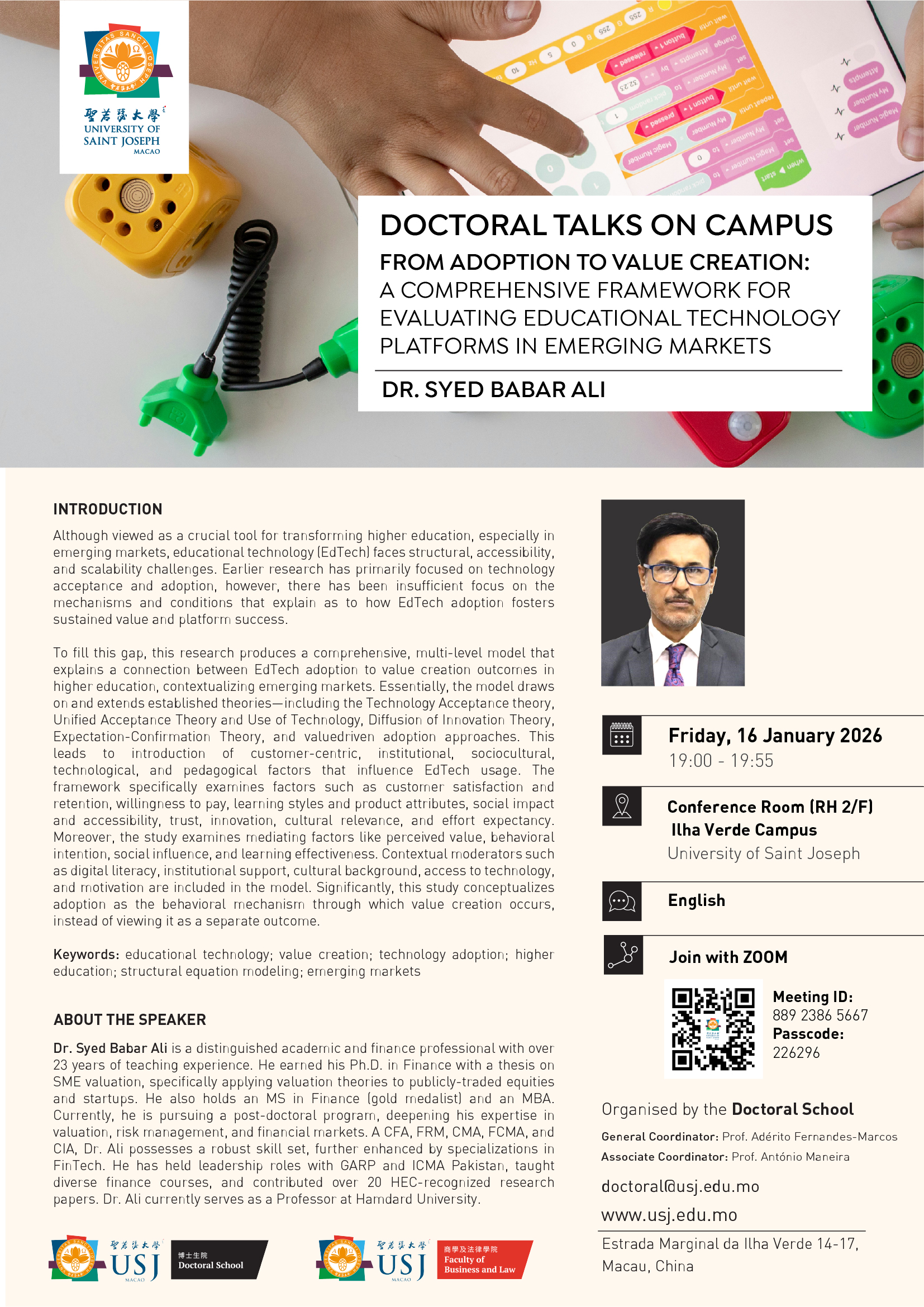
- Dr. Syed Babar Ali – ESI-USJ Postdoctoral Fellow
Abstract: Although viewed as a crucial tool for transforming higher education, especially in emerging markets, educational technology (EdTech) faces structural, accessibility, and scalability challenges. Earlier research has primarily focused on technology acceptance and adoption, however, there has been insufficient focus on the mechanisms and conditions that explain as to how EdTech adoption fosters sustained value and platform success.
To fill this gap, this research produces a comprehensive, multi-level model that explains a connection between EdTech adoption to value creation outcomes in higher education, contextualizing emerging markets. Essentially, the model draws on and extends established theories—including the Technology Acceptance theory, Unified Acceptance Theory and Use of Technology, Diffusion of Innovation Theory, Expectation-Confirmation Theory, and value-driven adoption approaches. This leads to introduction of customer-centric, institutional, socio-cultural, technological, and pedagogical factors that influence EdTech usage. The framework specifically examines factors such as customer satisfaction and retention, willingness to pay, learning styles and product attributes, social impact and accessibility, trust, innovation, cultural relevance, and effort expectancy. Moreover, the study examines mediating factors like perceived value, behavioral intention, social influence, and learning effectiveness. Contextual moderators such as digital literacy, institutional support, cultural background, access to technology, and motivation are included in the model. Significantly, this study conceptualizes adoption as the behavioral mechanism through which value creation occurs, instead of viewing it as a separate outcome.
19:55 Invited Speaker: Optimizing Short-Term Forecasts of Macau’s Gross Gaming Revenue and GDP Using Dynamic Factor Models with Machine Learning
- Dr Manuel Chau – fresh DBA graduate
Abstract: This project develops a robust short-term forecasting framework for Macau’s Gross Domestic Product (GDP) and Gross Gaming Revenue (GGR), essential for a “monotown” economy heavily reliant on gaming and tourism. The variables used are economic indicators from Macau, mainland China, Hong Kong, and the stock exchanges. The study evaluates econometric Dynamic Factor Models (DFM) alongside machine learning algorithms, including Random Forest, Gradient Boost, AdaBoost, K-Nearest Neighbors (KNN), and Elastic Net. Techniques such as Sequential Feature Selection (SFS), Recursive Feature Elimination (RFE), and cross-fold validation are employed to enhance accuracy and identify leading indicators.
Findings show that DFM combined with RFE-LASSO feature selection improves forecast accuracy and robustness compared to the baseline DFM. The research identifies the need for continuous refinement of the framework, including the incorporation of high-frequency and alternative data sources, exploration of additional feature selection methods beyond RFE and SFS, and advancement of prediction techniques, such as ensembling top-performing ML prediction techniques and integration of Quantum Machine Learning (QML), to further enhance predictive performance.
20:30 Coffee Break
21:00 Presentation by DBA student Nicolette Liao:
Reshape Macau by non-gaming initiative: A Case study of the six gaming concessions
This research examines how Macau’s six gaming concessions are diversifying through non-gaming initiatives under revised gaming laws. Using case studies of the six concessions: including secondary data analysis, expert interviews, and onsite observation for each case, it identifies the types of non-gaming activities offered, explores implementation challenges, and assesses their impact on casino performance and tourism. Initial findings from the literature review suggest that while events like concerts and festivals have boosted visitor numbers, further diversification is needed to enhance Macau’s appeal and reduce reliance on gaming revenue. The study highlights the role of non-gaming strategies in reshaping Macau’s tourism economy amid regulatory changes.
The Practice of Ethical Leadership and Its Impact on Employee Trust in the Private Sector of Timor-Leste
The leaders of an organization or institution in the for-profit private sector will play an important function in ensuring the successful execution of complex initiatives and decision-making. The purpose of this study is to examine how ethical leadership affects employee trust in Timor-Leste. When discussing ethical leadership, the leader takes the initiative to become an exemplary leader, thereby earning the trust of employees. Leadership without ethics and integrity can be harmful to the organizational stakeholders, particularly the employees.
The study aims to understand the relationship between ethical practices of the private-sector leaders and the level of trust experienced by employees. Ethical Leadership emphasizes leadership as something demonstrated through action, not merely through personal values or identity (Cunliffe, 2009). This approach is essential for achieving both profitability in the private sector and the broader economic prosperity of Timor-Leste. Developing mutual trust and employees’ commitment is a crucial step toward achieving organizational goals. Practicing ethical leadership is one of the effective ways to manage and strengthen employee trust, foster mutual understanding and cooperation, and enhance job commitment and job satisfaction, which ultimately leads to superior organizational performance. The study used qualitative and quantitative methods to research this study.